Time Management Strategies: prioritizing tasks
Written by Joseph Philipson.
Originally published September 30, 2024.
Part one of our five-part series on time management strategies.
All images are P3 originals, courtesy of Hadi Madwar.
Part 1: Prioritizing Tasks
Time management is essential for both your personal and professional lives. It can help you increase productivity and efficiency, reduce stress, and make better decisions.
Better time management will improve your work, giving you more opportunities to take on new projects, develop skills, or take up new hobbies.
There are several great time management strategies that will help, but today, we’ll focus on prioritizing tasks.
How to prioritize tasks
Having an order of operations or simply a plan will ensure you stay on task, focus on the right things, and work on tasks at times most conducive to getting things done.
Firstly, determine which tasks are most important and when to do them. From there, you can ignore or even delete many tasks, saving yourself a heap of time!
As always, this is easier said than done, but here are some of the best ways to prioritize tasks effectively and maximize your time.
The Eisenhower urgent - important matrix
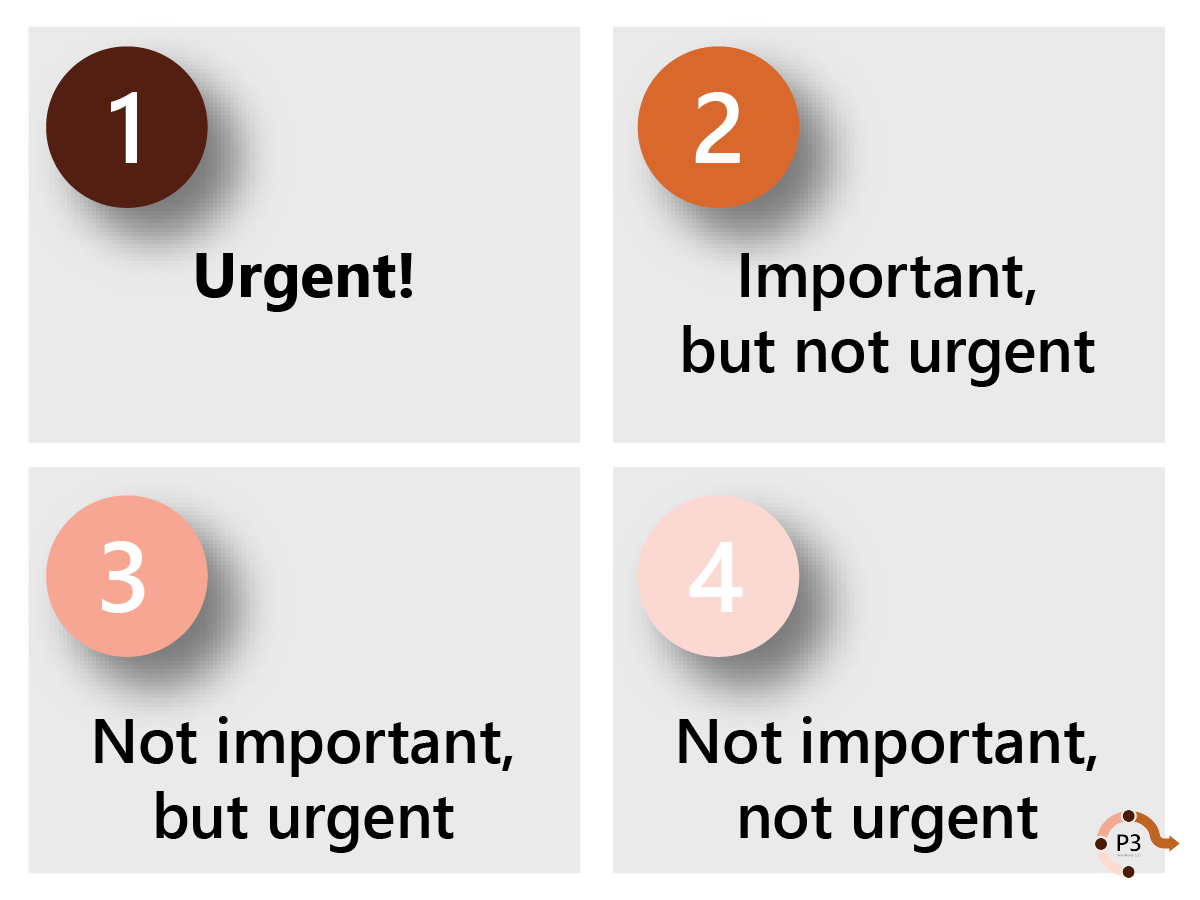
A list of the Eisenhower urgent-important categories.
The Eisenhower urgent-important matrix, or Eisenhower box, is a great and simple way to organize your tasks.
Place tasks in one of four boxes according to urgency and importance. Decide whether each task is urgent or important.
Urgent and important tasks are a high priority, so you should do them now.
You should schedule non-urgent but important tasks for a later time.
Delegate tasks that aren't important but urgent.
Finally, tasks you determine are neither important nor urgent are time-wasting. You can eliminate all of these.
The 80/20 rule or pareto principle
Without going into the math (because who wants that in a blog article?), the 80/20 principle means that 20% of causes are responsible for 80% of the outcomes.
In the context of time management, 20% of the highest-priority tasks will get 80% of the work done. So, identifying and focusing on these high-priority tasks can significantly boost your productivity.
Look for low-hanging fruit and tasks that will yield the highest results. From there, you can prioritize your essential 20%.
The ABC method
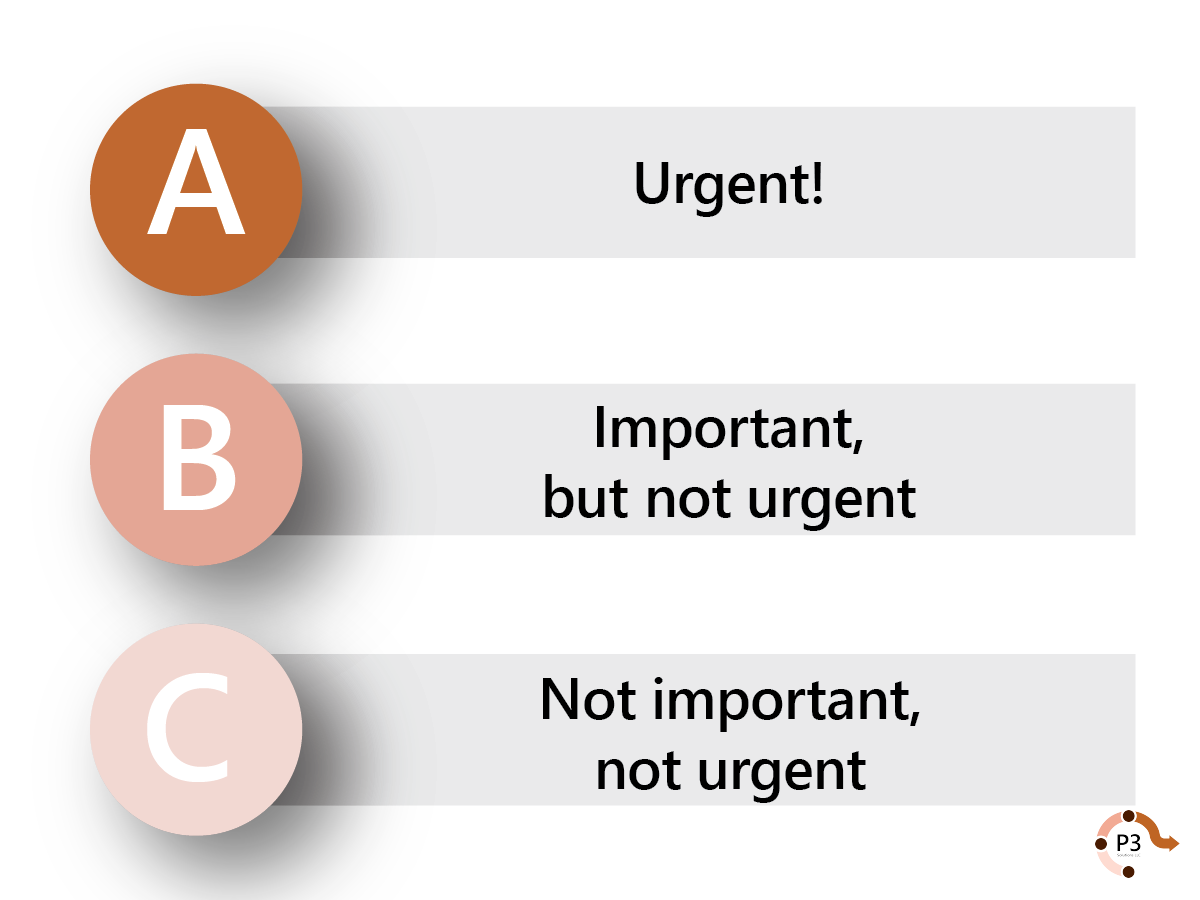
The ABC method
The ABC method is a simple way of categorizing tasks with three labels. Tasks labeled A are the highest priority, and tasks labeled C are the lowest.
Put simply, here are some of the typical ways you could categorize your tasks:
A: Any tasks you need to complete with great urgency. These are usually the tasks you have that have a deadline, particularly one coming soon.
B: Label tasks as B if they don’t have a deadline but still need completion. You can move on to these tasks once you’ve finished the tasks labeled “A.”
C: Tasks without deadlines that aren’t very important can be labeled C. In keeping with the hierarchy of these tasks, only complete these tasks once you’ve finished all the A and B tasks.
This is the basic version of the ABC method, but if all your tasks don’t comfortably fit into just three categories, you can always expand this method using more letters.
If you need five categories to prioritize tasks, your ABC method becomes an ABCDE method. Either way, the important thing is to start with the most critical tasks and leave the others until later.
The MoSCoW prioritization method
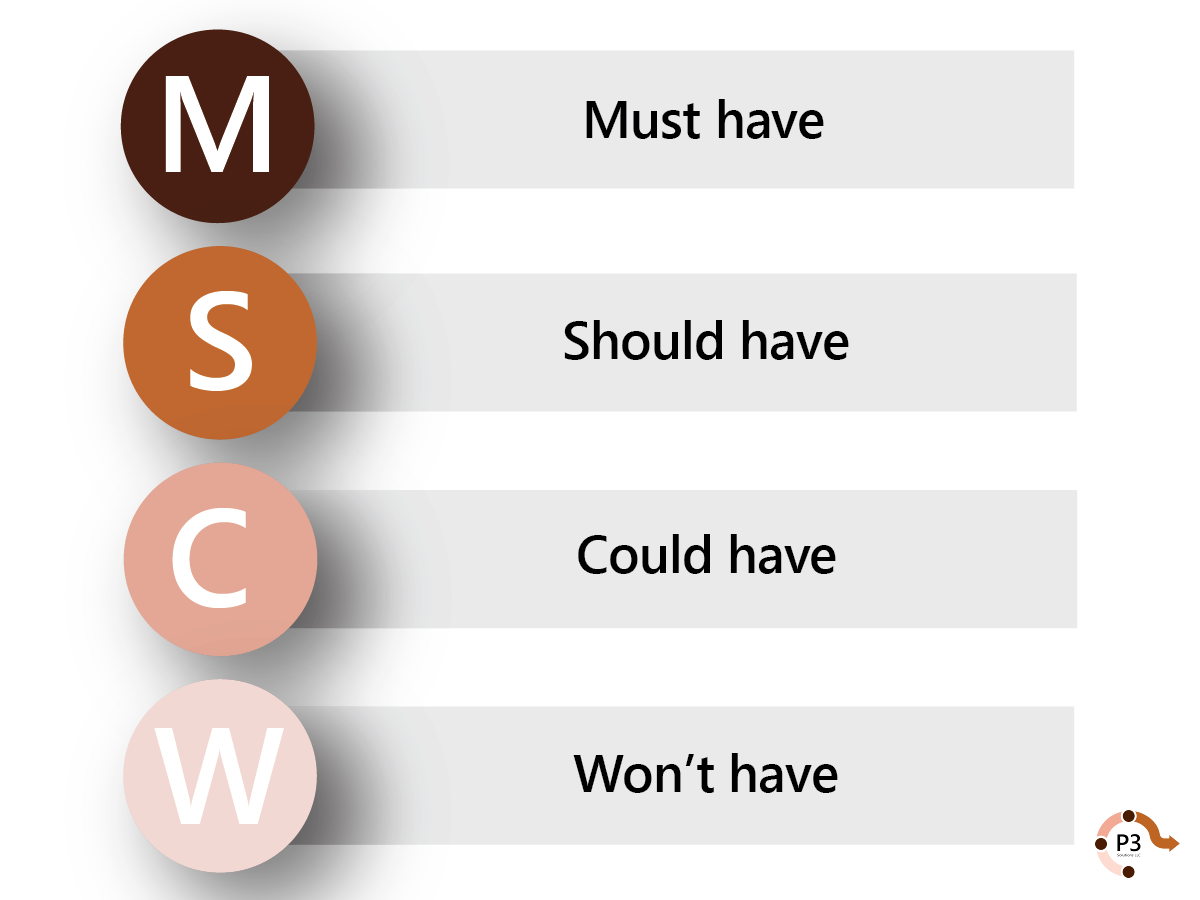
The MoSCoW method
The MoSCoW prioritization method, similar to the ABC method, adds more meaning to the tasks than simply categorizing them alphabetically.
It’s not even really the MoSCoW method but the MSCW method. However, that isn’t as catchy, so they added other letters to make it pronounceable and memorable.
This approach came straight out of software development in the 1990s. It is much better for projects with various iterations, like software builds, writing drafts, or specific larger projects that require a lot of back-and-forth between two or more parties.
The four letters stand for:
M: Must have.
These tasks are essential for any project. You can only complete the project by completing these tasks.
S: Should have.
Should-have tasks are preferable but won’t necessarily be essential in this build or iteration of the project.
C: Could have.
The could-have tasks would be a nice addition and are usually tasks you can complete if time permits.
W: Won’t have
These tasks aren’t worth the time for the current iteration of a project. Perhaps they’ll be included in a later version, draft, or build.
While the MoSCoW method does add meaning to task prioritization, it might be worthwhile sticking to the ABC method when working with international teams, especially if they don’t use English as their working language.
Eat the frog
Say you have several tasks, all with similar deadlines, and you need to plan your day. At this point, the order of the tasks is no longer critical since every task is of comparable importance and has the same deadlines.
Start with the most difficult at the beginning of your day or week. This is not only about time management but also about performance management.
Typically, performance will decrease throughout the day. While starting each day or week with difficult tasks won’t be as fun, you’ll be glad to have them completed later in the day or week when energy levels and enthusiasm might be lower.
It’s called “Eat the frog” because of this quote:
“If it's your job to eat a frog, it's best to do it first thing in the morning. And If it's your job to eat two frogs, it's best to eat the biggest one first.” - Mark Twain.
This approach works well because you get things done when you’re productive, won’t stress about looming deadlines (provided you’ve already got the important stuff done), and will build momentum as you progress through the day and the week.
Ultimately, you’ll enjoy the last moments of each day and before the weekend as you tackle more straightforward and enjoyable tasks.
Need help to complete your project on time? P3 Solutions can help!
We thrive on the challenge of creating exceptional written content, provide business development processes to help you stay ahead of the competition, and mission-critical business solutions.
Contact us and tell us how we can help you meet your next challenge.
Further reading:
The teamwork blog: https://www.teamwork.com/blog/how-to-prioritize-tasks/
WeWork ideas: https://www.wework.com/ideas/professional-development/creativity-culture/how-to-prioritize-tasks
Asana: https://asana.com/resources/how-prioritize-tasks-work