
Learning new skills
Written by Joseph Philipson.
Originally published February 10, 2025.
All images are P3 originals, courtesy of Hadi Madwar.
The importance of learning new skills
Now more than ever, learning new professional skills is essential. Every day, how we work dramatically changes and those who don't adapt or develop new skills will be left behind professionally.
Learning new skills can open up new opportunities, advance your career, or simply keep you in your current job by ensuring that you stay competitive.
There are also plenty of personal benefits to learning new skills like improved cognitive ability and better problem-solving, but for today, we'll simply focus on learning new professional skills.
Learning strategies and techniques
The difference between learning a new skill and failing miserably occurs before you even start learning. You need to use the right learning strategies and techniques, else skill acquisition will likely be a frustrating and unsuccessful experience.
Luckily for you, here are a few of our favorite approaches for learning new skills because in addition to offering unparalleled professional training and mentoring services, a lot of us have also spent years teaching.
Here are some of the learning strategies and techniques you need to get started, make a note of them before you embark on learning any new professional skill.
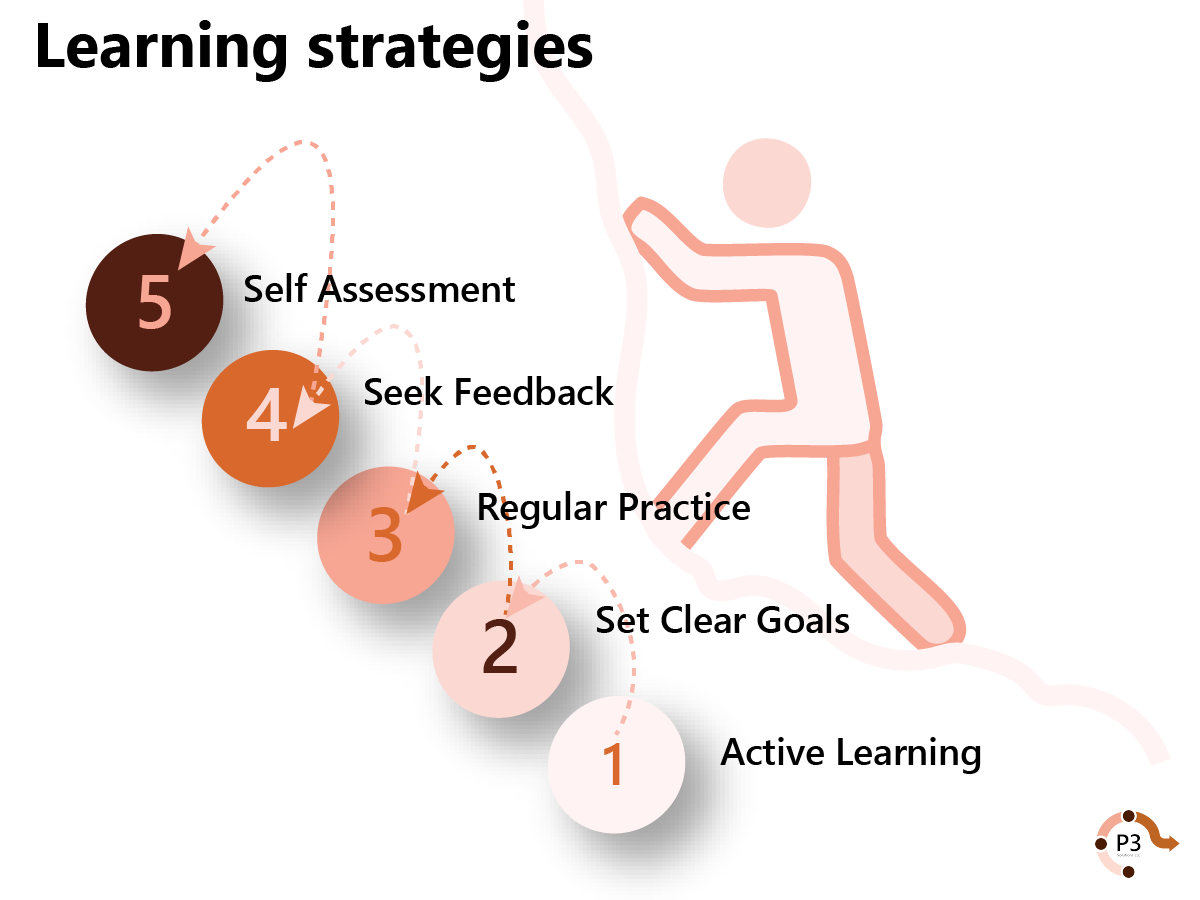
1. Active Learning: No matter what skill you're trying to learn or develop, you need to engage actively with the learning process. This means asking questions if you're in a class, discussing what you're learning, and applying these concepts in the real world. This active process helps solidify new information in your mind.
2. Set Clear Goals: The quickest way to fail is by setting the bar too low or too high. That said, it's better to set smaller, achievable goals, as not only does this make progress tracking easier, it also helps you to stay motivated.
3. Regular Practice: No matter what skill you're trying to learn, practice does indeed make perfect. Aside from those irritating people who seem to be good at everything they try, most people spend incredible amounts of time practicing the skills that they're best at. Just ask the greatest athletes how much they train, it's often more hours each week than most people work.
4. Seek Feedback: To really see any improvement, you need to look for regular feedback. Look for feedback from peers, mentors, teachers, or tutors. Highlight any areas where you can improve and implement this feedback and advice into your learning plans going forward.
5. Self-Assessment: Critically evaluating yourself is easier said than done, especially if you're not an expert. Remember to celebrate your own progress but also to align your own progress with predetermined goals you set yourself.
Now that you're aware of some of the key learning approaches that should permeate the whole process, let's see the steps we should take to learn a new professional skill.
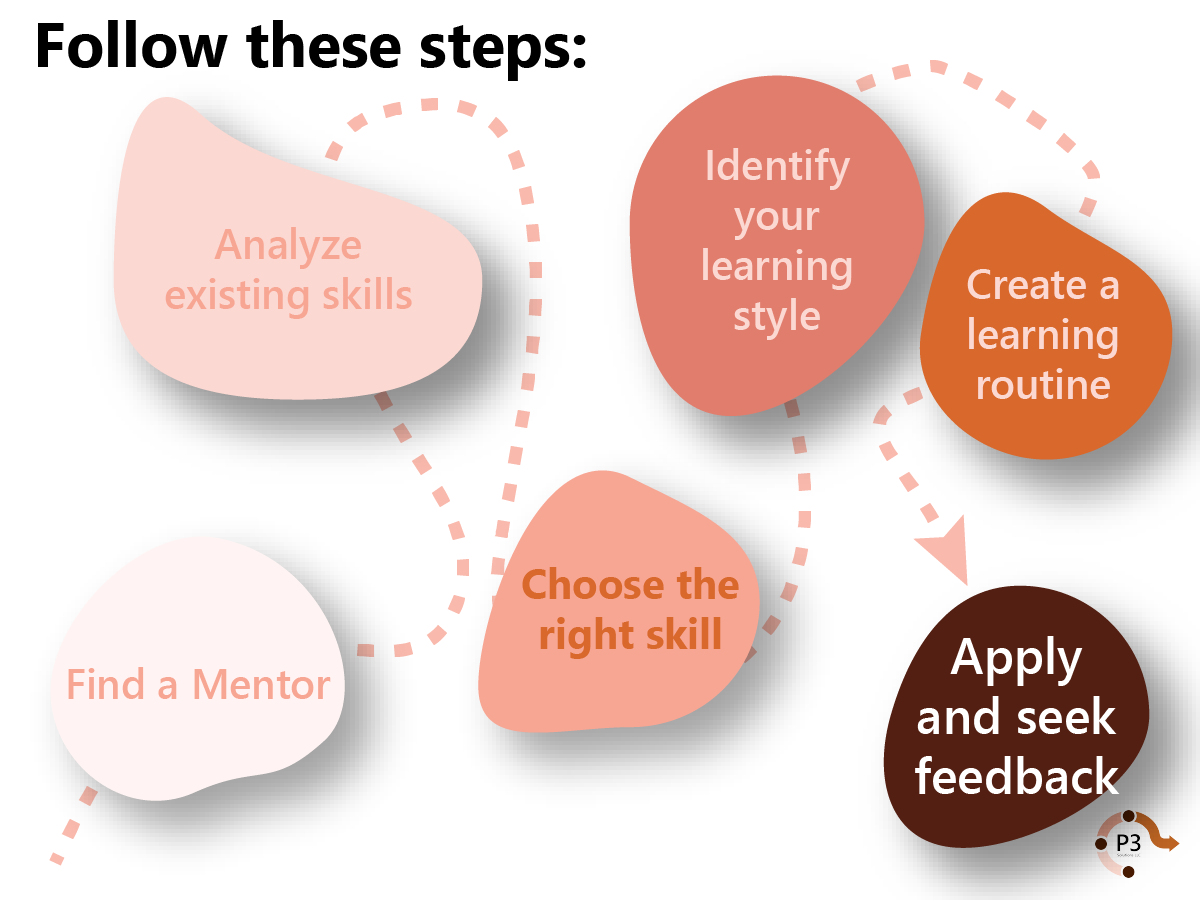
1. Find a mentor
As one of our key learning strategies, we mentioned the importance of seeking feedback. One way to get this feedback is from a mentor.
Not only will a mentor provide feedback, but they can also offer valuable insights, guidance, and support during your learning journey.
Having trouble finding a mentor? P3’s cross-trained team can help.
Using our expert skills and experience, we can help you avoid common pitfalls, speed up your progress, and even work with you on choosing the right skills to learn (more on that shortly!).
2. Analyze existing skills
Before you embark on a likely-lengthy journey of developing new professional skills, you should analyze your current skills.
For one, before you learn a new skill, you might actually find out you're not as good at that one thing as you thought you were, or that it's been so long that you're a bit rusty.
Your new professional skill may actually be something you thought you already new, or something that's changed so much in recent years, that your current skillset is no longer relevant.
If your skills are all up-to-date, then working out exactly what these are will at least help you work out which skills are complementary to your current skillset, or which are notably missing from your current skills.
Self-awareness will help you set much more realistic and achievable learning objectives for your new skills.
If you're struggling to remain objective and unbiased as you analyze your existing skills, don't forget that your mentor can always help you with this.
3. Choose the right skill
Another thing your mentor can help you with is choosing the right skills. There are a few things to consider here like the kinds of skills you could learn, what you're good at, what your desired or current industry is looking for, and which skills will ultimately help you the most professionally.
You'll likely want to prioritize skills that complement your existing skill set. For example, it'd be better for a seamstress to learn how to knit or crochet than to weld.
Even the adage “Jack of all trades” is no longer as bad as it once was. Modern employers often require versatile employees as much as they require experts.
You'll also want to look for skills that are useful for your industry and in demand. If you're learning an industry-specific skill that everybody already has, it won't help you stand out or find work. Look for the skills that are needed but are yet to be put to good use by employers.
4. Identify your learning style
Once you pick your desired skill, the arduous task of learning it is about to begin. While it can be really tempting to dive straight in and start learning, we wouldn't recommend it.
The beginning of any learning process is arguably the most fun. Enthusiasm is high and the first steps are often some of the biggest where every day seems like you're learning something new and making a lot of progress.
However, without identifying your learning style, you'll start to hit roadblocks. These will be little more than molehills in the earliest stages, but as you get to the more advanced aspects of any skill, ineffective study techniques that don't match your learning style will be limited.
Work out how you learn best. You should already have an idea of what this is.
If it's been a while since you really learned anything new, think back to your schooling. Your favorite classes and teachers will give you a great idea of your learning style.
Typically, educators outline learning styles predominantly based on sensory inputs and styles, gravitating to learning models that lean into visual, auditory, or tactile learners.
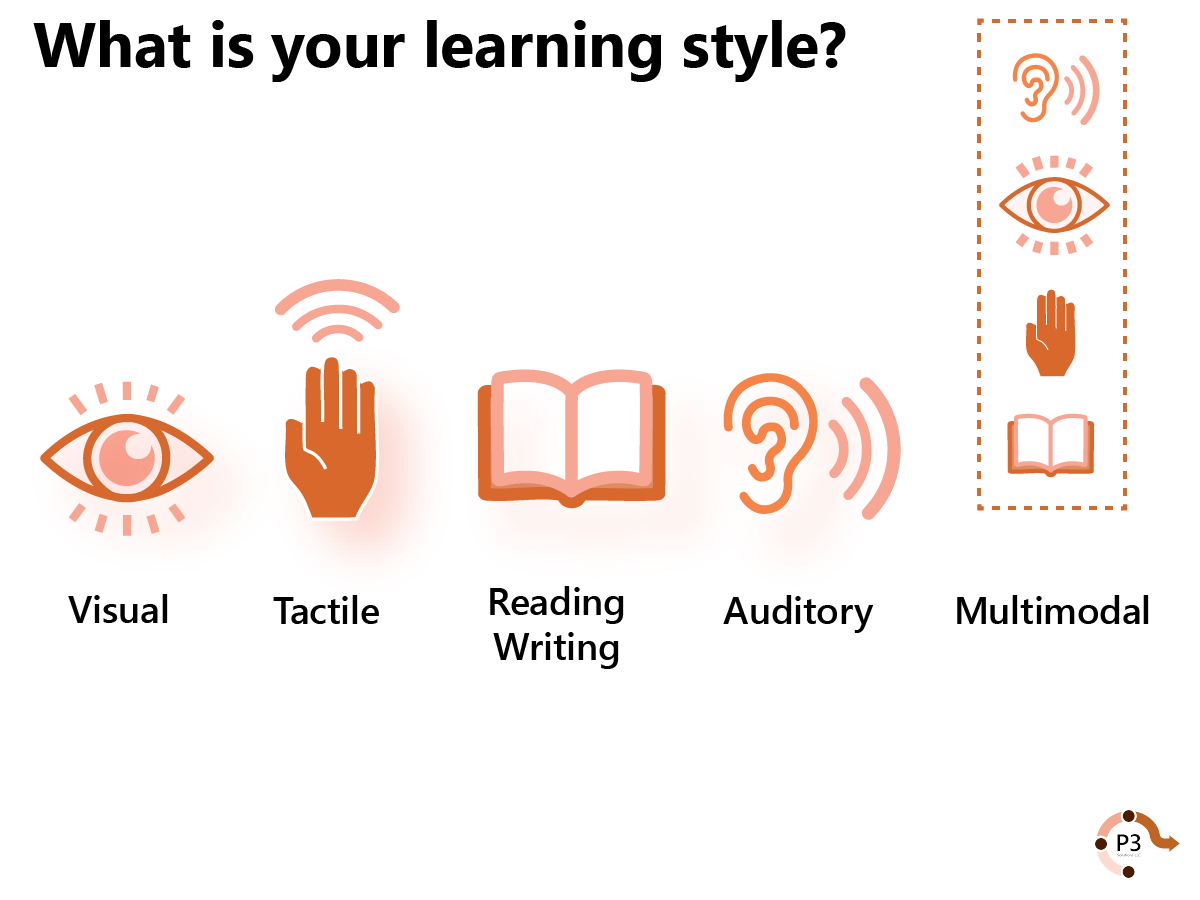
Visual learners prefer information presented visually like diagrams, charts, illustrations and learn incredibly well from videos. They also like detailed notes with color-coding and remember faces more easily than names.
Auditory learners prefer listening. They learn well through discussions and debates, explanations, and will remember conversations and speeches well.
Kinesthetic or tactile learners enjoy hands-on approaches. They learn more quickly by doing, especially when this involves physically manipulating objects and participating in activities.
Reading / writing learners prefer to read information, make lists, take notes, and rewrite information to help them remember. They'll learn well from textbooks, manuals, and articles.
Multimodal learners don't display any real preference for the different learning styles and learn with a variety of different approaches.
In reality, learners won't ever have an absolute preference, but they're more a mix of different learning styles with a preference rather than being incapable of learning with different learning styles. In some sense, every learner is multimodal to some extent and needs to work out and fine-tune the balance of materials and approaches that matches their own personal learning style.
For example, a visual learner won't necessarily be able to learn a new skill by simply watching YouTube tutorials. They can learn a lot from them, but they can still listen to podcasts and practice their new skills.
5. Create a learning routine
Instead of pigeon-holing yourself into a particular learning style, prioritize learning approaches that match your preferred learning style while including other approaches that you've also found to be effective.
Visual learners should look to learn with mind maps, charts, and infographics while watching educational videos and animations on the skills they'd like to learn. They can also take notes as sketches rather than writing.
Auditory learners should look for podcasts, audiobooks, and recorded lectures on the skills or subjects they want to learn more about. Where possible, they should try and engage in discussions and study groups. Auditory learners can do well in classes or with a mentor.
Kinesthetic or tactile learners should look for workshops, labs, or simulations of the skills they want to learn. They should attempt to learn the practical side of skills, preferring applications over theory.
Reading / writing learners can create learning routines using as many reading materials as they can. Look for authoritative books and publications on the skills you want to learn and set aside reading and writing time as part of your learning routine.
Multimodal learners can combine any of the above advice in line with their learning preferences. In reality, every learner should be finding the sweet spot that matches how much they prefer each learning approach. Be flexible and remember that you can alter your learning routine on the fly, especially if one day you're not feeling like your current resources and approaches aren't working.
Routines are incredibly powerful for developing skills. For tips on creating routines, take a look at our 5-part series on time management. You can't just wing it. Be sure to form healthy learning habits, be disciplined, and break your bigger goals into more achievable goals.
The easiest way to fail is simply by giving up or putting off learning your new skill. Discipline is important, but it only works if you get into the habit of learning in a way that's sustainable.
Too many people start with heaps of enthusiasm when learning the basics of a new skill before dropping off when things get difficult because they've burned themselves out.
6. Apply what you learn and seek feedback
A great way to stay motivated when learning any new skill is by seeing it in use or at least being able to see the value of it.
Using your new skills in a real-world context not only teaches you more about them, but it will bridge the gap between theory and practice.
Learning to drive in a parking lot is a nice way to practice and get used to how a car works, but anyone will tell you that the freeway during rush hour isn't anything like an empty parking lot.
We mentioned getting feedback earlier and can't stress enough just how important this is, especially if you're predominantly teaching yourself your new skill or spending many hours unsupervised.
A tutor or mentor will offer personalized feedback, but it's important that you have a mentor with you throughout most of the learning journey. Bad habits are incredibly tough to break so look to mentoring as early as possible and even before your new skill acquisition.
After all, your mentor can even help you choose which skills you should be learning.
Contact us and tell us how we can help you on your path to learning new skills.
Further reading:
LinkedIn: https://www.linkedin.com/pulse/beginners-guide-choosing-right-professional-hzxjc/
Millennial Grace: https://www.millennialgrace.com/benefits-of-learning-new-skills/
UNC: https://www.unc.edu/discover/expertise-expert-offers-8-tips-for-learning-a-new-skill/