
Time Management Strategies: assess
Written by Joseph Philipson.
Originally published January 22, 2025.
Part five of our five-part series on time management strategies.
All images are P3 originals, courtesy of Hadi Madwar.
Assess your strategies
In the final part of our series on time management, we need to take a hard look at ourselves.
By this point, you've done everything you can to work out when you should do each of your tasks and in which order. You should also have made sure that you're looking after yourself. All that really remains is to start getting things done.
Of course, we always implied that you'd use these strategies and then do what you're supposed to, but we have yet to detail getting things done. Instead, we've looked at everything you can do to ensure you manage your time well.
Now, it's time to ensure every strategy works as it should.
Audit your time
By auditing your time, you're taking a significant step towards validating your time management strategies. This process will empower you with a clear understanding of how you use your time, putting you in control of your productivity.
Some great tips here from Lucidchart.
You'll never know if you've improved your productivity or time management if you don't monitor this.
A time audit will provide a clear picture of why time is being wasted, where time can be gained, and how quickly you can get things done.
This process can bring a sense of relief, as you identify and eliminate time-wasting activities.
Track your daily activities, set reminders to track them, analyze where you can improve, and use this information to plan and prioritize your work.
If you need help prioritizing tasks effectively, a time audit will make all the difference. You may be surprised by some of the results of your time audit.
Here's a quick and easy way to get started auditing your time:
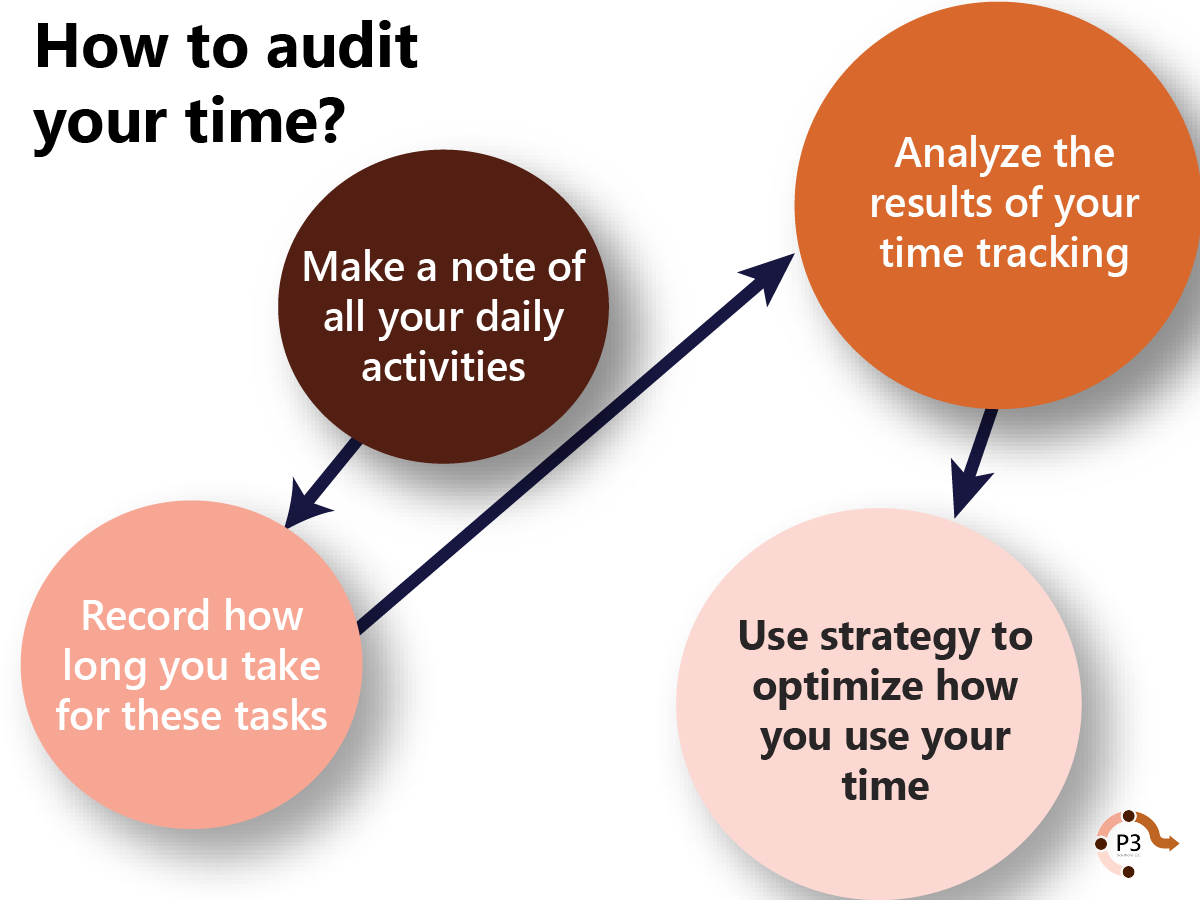
Make a note of all of your daily activities (both personal and professional tasks)
Record how long you take for these tasks (set alarms if you remind yourself to do this).
Analyze the results of your time tracking (more on this shortly).
Use the strategies from our other articles (particularly on prioritizing tasks) to optimize how you use your time.
The biggest gains in time management will be from the low-hanging fruit—the things you didn't even realize were eating up all your time. There may be seemingly simple tasks that could be done in batches or at a better time of day.
You'll also see which tasks may be worth investing in. More often than not, a product or service exists to make specific tasks easier or take less time. If you find something is getting in the way of your productivity and there aren't any simple ways to optimize it, then there may be solutions out there that you could pay for or invest in.
Time tracking

Tracking your time is essential. There are ways to do this with technology (as mentioned earlier), or you can do this in a lo-fi way by noting what you did and how long it took.
Here’s a list of 9 FREE time-tracking apps.
As part of your time audit, you'll be tracking how long almost everything you do takes. Simply noting how long it takes is a good way to see how these tasks fit into your day and the overall duration, but time-tracking apps, especially for computer-based tasks, are an excellent way to track tasks in more detail.
Many time-tracking apps include integrations into the tools you might be using for work, which is particularly useful for freelancers or anyone working at an hourly rate.
For those of us who get distracted, which is easily done given that the internet is largely a distraction machine by now, some of these apps can show where and when you start to lose focus.
With lots of time-tracking apps out there, look for the ones that offer good integration with the tools you regularly use, are easy to use, and give you the option to set a manual timer. After all, only some of the activities that you'll track use a computer. You might find that some of your "offline" tasks are where you can make the most significant gains.
Assess your time management skills
If you need to improve at multitasking, often get distracted, or procrastinate, assessing your time management skills is worthwhile. Try to see how much time you're wasting with distractions and limit or remove them where possible. Complete an entire audit of how you use your time and look for areas to improve.
With a plan for your time audit and the right apps, it's time to review all the data you've gathered.
A really simple thing you can do for each task is to start by guessing how long it will take you. This will help you calibrate your perception of time and see where you're overestimating or underestimating the impact of all of your tasks.
If you often need help to be on time for things or meet deadlines, you may be distracted or simply prone to underestimating how long specific tasks generally take. Finding out something takes longer than you thought could help you prioritize such tasks or start them a bit earlier.
Use your time audit to see how well you stay on task, too. Simply being aware of when you're procrastinating or getting distracted makes it easier to avoid. Once you've assessed where the problems lie, you can integrate the strategies from our other articles for taking breaks and avoiding distractions.
Combine these strategies with everything we've covered so far, and you'll be in great stead to get the most out of your time inside or outside of work and live a more productive and healthier life as a result!
Good luck.
Need help to complete your project on time? P3 Solutions can help!
We thrive on the challenge of creating exceptional written content, provide business development processes to help you stay ahead of the competition, and mission-critical business solutions.
Contact us and tell us how we can help you meet your next challenge.
Further reading:
Hubstaff: https://hubstaff.com/time-tracking/time-audit
Time doctor blog: https://www.timedoctor.com/blog/time-audit/
Timely blog: https://timelyapp.com/blog/time-audit