How to Uncover the Client’s Real Problem Before Writing the Proposal
Written by Joseph Philipson.
Originally published December 30, 2025.
All images have been generated using AI, unless otherwise stated.
Proposals don't fail because of the writing quality, formatting, or compliance; they fail because they didn't start with a sufficiently thorough understanding of the problem they set out to solve. Many organizations treat proposals as a description of the client's needs, constraints, and success criteria. Proposal teams assume that the problem has been correctly defined, even when it hasn't.
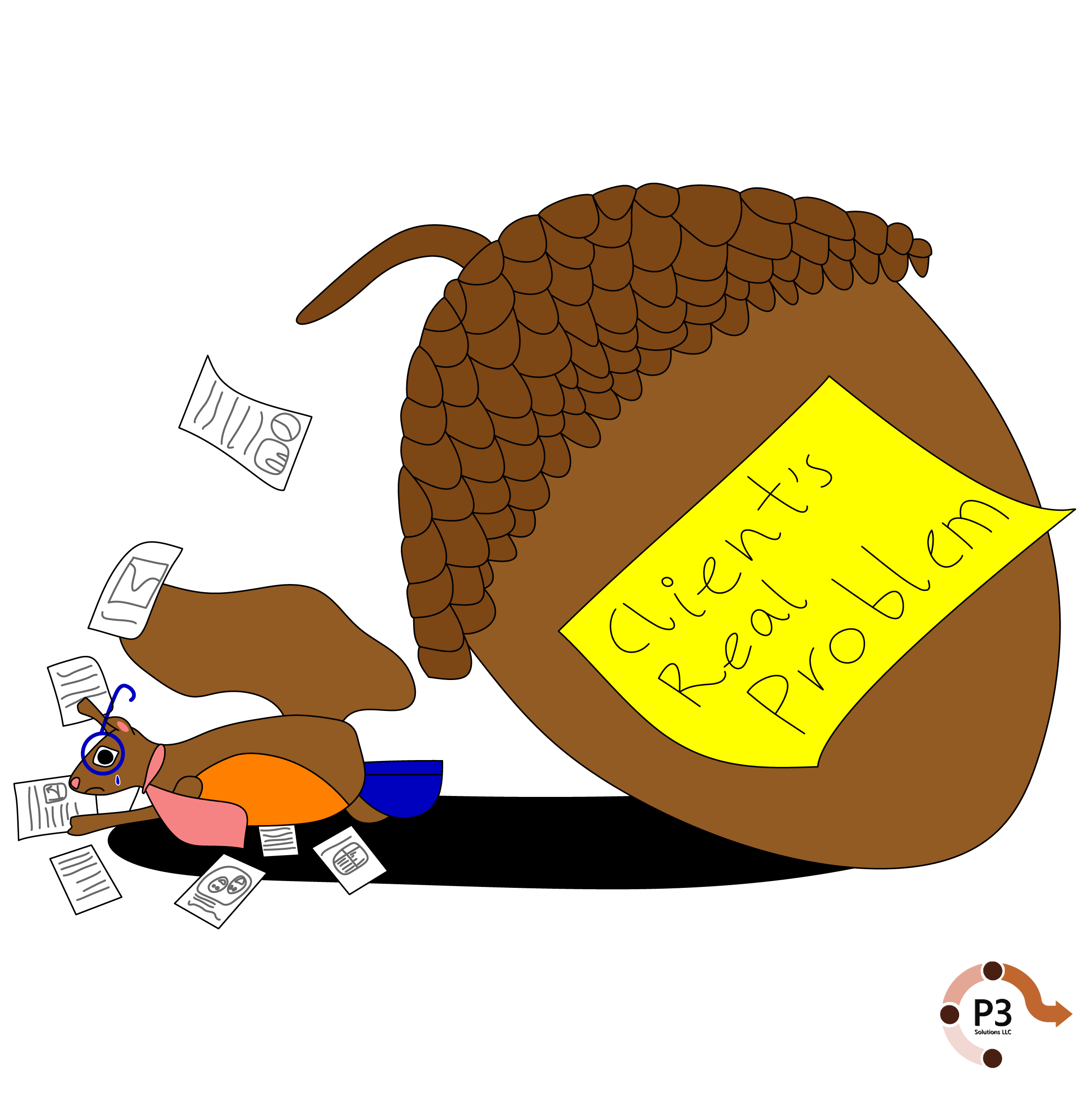
Wendy digging through RFP papers, ignoring a huge acorn labeled “Client’s Real Problem.” Imagy by Hadi Madwar.
RFP's aren't diagnostic documents; they're procurement tools. They should reflect what an organization is prepared to ask for, rather than necessarily asking for specifically what it needs. Organizations move to solutions too quickly and lock in assumptions before understanding the underlying issues.
Proposals really begin by questioning the problem as presented, testing assumptions, and clarifying before committing to the solution. Understanding the client's real issue is the foundation of proposal writing, not just a preliminary step.
Why RFPs Aren’t Enough
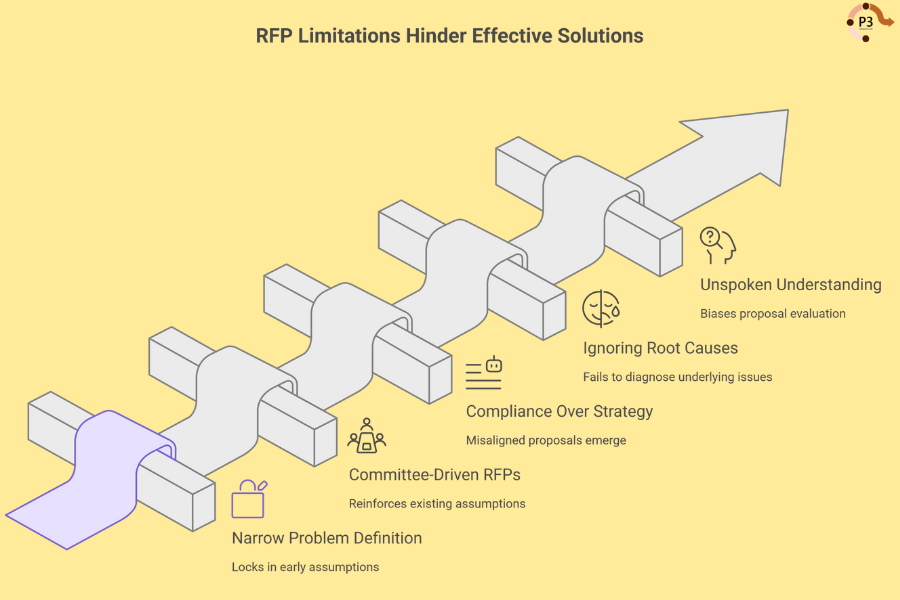
RFP limitations hinder effective solutions
Requests for proposals (RFPs) are supposed to create order in complex purchasing environments. They should support governance and enable organizations to compare suppliers consistently. They're essential for regulated and high-risk environments, but the problem is that RFPs are often treated as descriptions of the problem to be solved.
An RFP should reflect what an organization is willing to formalize at a given time, including negotiated requirements, risk considerations, and language that withstands both internal and external scrutiny. It's not there to capture why the situation exists in the first place.
Organizations frequently define problems too narrowly and too early, locking in assumptions without really examining the underlying causes. Issues can arise further down the line as these early assumptions shape subsequent decisions.
Committees usually produce RFPs rather than the single owners of the problem. Formal procurement processes often reinforce the existing assumptions and systems rather than challenging them, especially when accountability and auditability are priorities.
With the wheels in motion, the RFP is difficult to question as proposal teams are encouraged to align with its language. Compliance is measurable and defensible, after all. It can feel risky to deviate from the stated requirements. Once the early assumptions are formalized, they become anchors that are rarely revisited or even questioned, even if they're flawed.
Decision-makers assess proposals against the broader (and often unspoken) understanding of the problem. Leaders look for clarity, relevance, and risk framing for making judgments, even when technical completeness may be lacking.
· RFPs are designed to support procurement and governance, not to diagnose root causes.
· The problem definition in an RFP reflects consensus and risk tolerance, not necessarily reality.
· Early framing decisions shape every downstream choice, including how proposals are evaluated.
· Strict compliance can produce technically strong proposals that feel strategically misaligned.
· Treating an RFP as a starting signal, rather than a diagnosis, creates space for better solutions.
Conduct Discovery Sessions
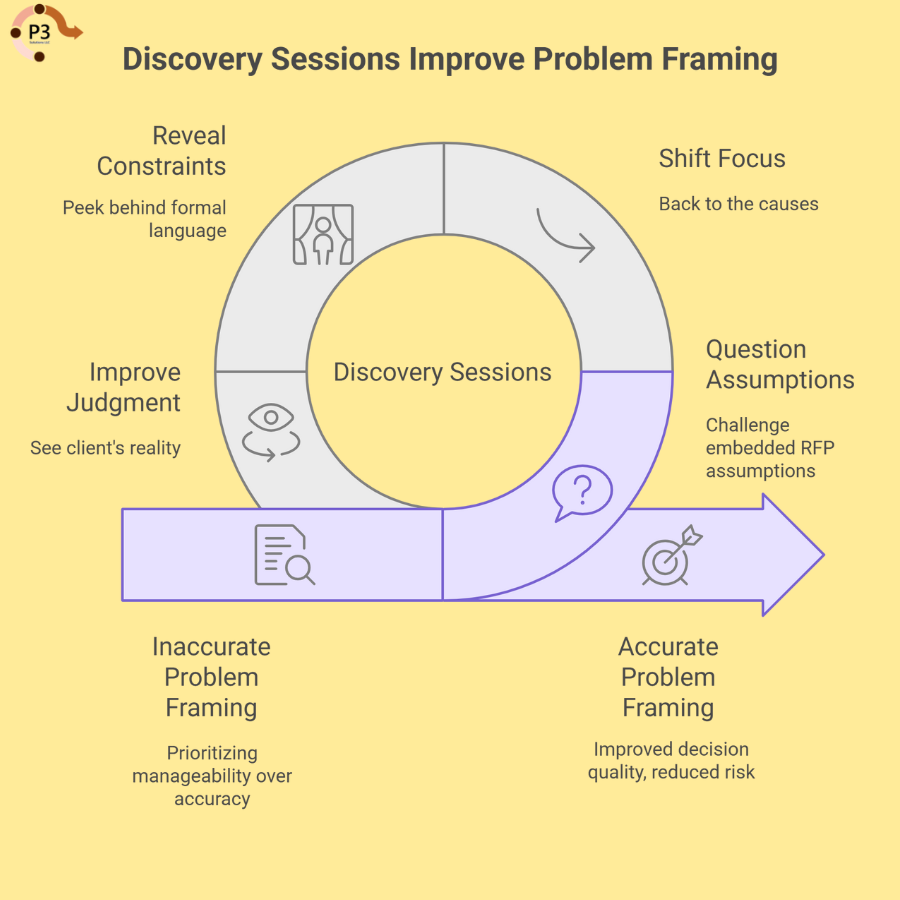
Discovery sessions improve problem framing
If there's one thing discovery sessions do well, it's slow down the organization long enough to test the framing of the problem. They have nothing to do with sales, and they aren't requirements-gathering exercises. They create the space to question the assumptions embedded in the RFP.
Organizations can fall into the trap of defining problems in ways that prioritize manageability over accuracy. Framed problems are difficult to revisit, even in the face of evidence suggesting that the framing is incomplete. Discovery sessions can shift the focus away from solutions and back to the causes.
Compliance requirements and reporting frameworks usually shape RFPs, which can smooth the edges of ambiguity without directly offering more concrete solutions. With discovery sessions, there's a chance to peek behind the curtain of formal language, institutional constraints, competing priorities, and risk sensitivities that mightn't be explicitly written down.
Discovery sessions can improve judgment, reveal where objectives hide deeper structural issues, and highlight where requirements describe symptoms rather than causes. Here, proposal teams can see the client's reality, rather than just aligning with the document.
Discovery can also help reduce downstream delivery risk. Early framing errors can snowball if problems are misdiagnosed in the proposal stage. Discovery isn't an added step; it's a form of risk mitigation.
· Discovery sessions test the accuracy of the problem framing, not to validate requirements.
· In donor and public sector contexts, RFPs often prioritize compliance over clarity.
· Formal documentation can obscure institutional constraints and internal trade-offs.
· Early assumptions shape both the relevance of the proposal and its delivery outcomes.
· Strong discovery improves decision quality and reduces implementation risk.
Conduct Stakeholder Interviews
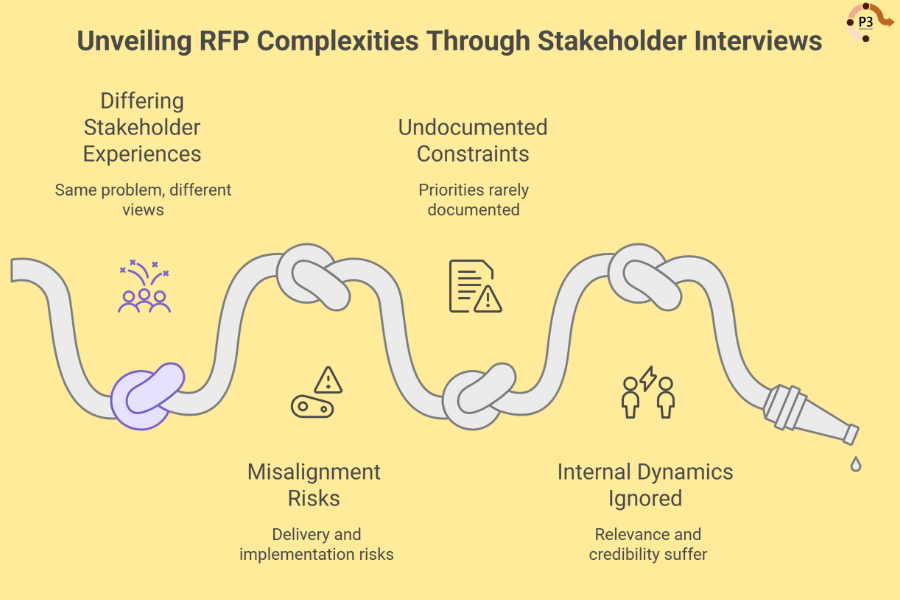
Unveiling RFP complexities through stakeholder interviews
In larger and more complex organizations, the issues that can arise in an RFP aren't the result of a single actor. Instead, multiple actors are at play, each with distinct responsibilities, incentives, and constraints. Stakeholder interviews can expose how the same issue is understood differently across organizations.
Documents often present a unified narrative, whereas interviews can reveal different understandings of it. Program teams, procurement units, finance, leadership, and external partners can understand problems in fundamentally different ways. Differences are often left unexamined, with organizations simply defaulting to the formalized definitions that feel coherent but don't really reflect reality.
In donor-funded and public sector environments, RFPs are great for checking boxes on governance, audit, and compliance, but they mask the cracks of internal disagreements and unresolved trade-offs. Stakeholder interviews can highlight underlying issues that RFPs may have inadvertently overlooked.
It isn't usually a case of resistance to change itself; it's just that misalignment, uncertainty, or a lack of involvement in defining the problem has become too deeply rooted in the issue. Interviews can uncover these roots and identify where priorities conflict and where assumptions are being made.
Stakeholder interviews aren't supposed to find consensus; they're supposed to clarify and reveal incompatible objectives, differing expectations, and implementation risks. Proposal teams can use these insights to acknowledge the complexity of issues rather than paper over them. Proposals that understand these issues are more credible, even if they challenge the client's initial framing.
· RFPs often present a single narrative where multiple perspectives exist.
· Different stakeholders experience the same problem in different ways.
· Misalignment is a common source of delivery and implementation risk.
· Interviews surface constraints and priorities that are rarely documented.
· Understanding internal dynamics improves proposal relevance and credibility.
Map the Client Journey
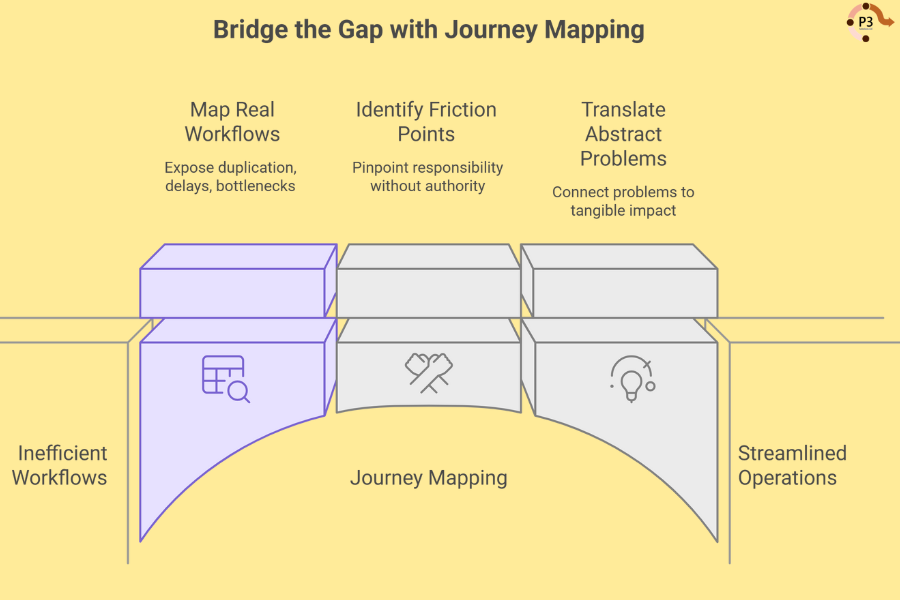
Bridge the gap with journey mapping
The RFP will describe what the organization intends to do, and client journey mapping reveals how the work actually happens; the gap between the two is where the real problem likes to sit. Formal processes can satisfy governance, reporting, and accountability requirements, but the day-to-day work isn't always reflective of them. Pressure, resource constraints, and informal decision-making can all lead to a tangible gap between formal processes and how things actually get done.
Journey mapping can trace how activities move across teams, approvals, and handoffs. A large portion of organizational effort doesn't really add any value. By mapping real workflows, you can expose duplication, delays, rework, and bottlenecks that aren't present in formal documentation. These inefficiencies are often the reason initiatives underperform, even when they look technically sound on paper.
When multiple actors share responsibility but not authority, friction can occur at specific points. You won't usually see these friction points in an RFP, but they'll affect cost, timing, risk exposure, and stakeholder satisfaction. Hidden inefficiencies are not only costly, but they're often woefully underestimated.
By mapping the client journey, you can translate abstract problems into impact. Delays cost time, workarounds cost money, and repeated approvals can be risky. Proposal teams can focus on operational realities, and a shared reference point can reduce ambiguity when evaluating success.
· Formal processes rarely reflect how work actually gets done.
· Journey mapping exposes delays, duplication, and hidden friction.
· Many delivery risks originate in handoffs and approvals, not capabilities.
· Operational inefficiencies often carry underestimated indirect costs.
· Proposals grounded in real workflows feel more credible and achievable.
Translate Findings into Proposal Strategy
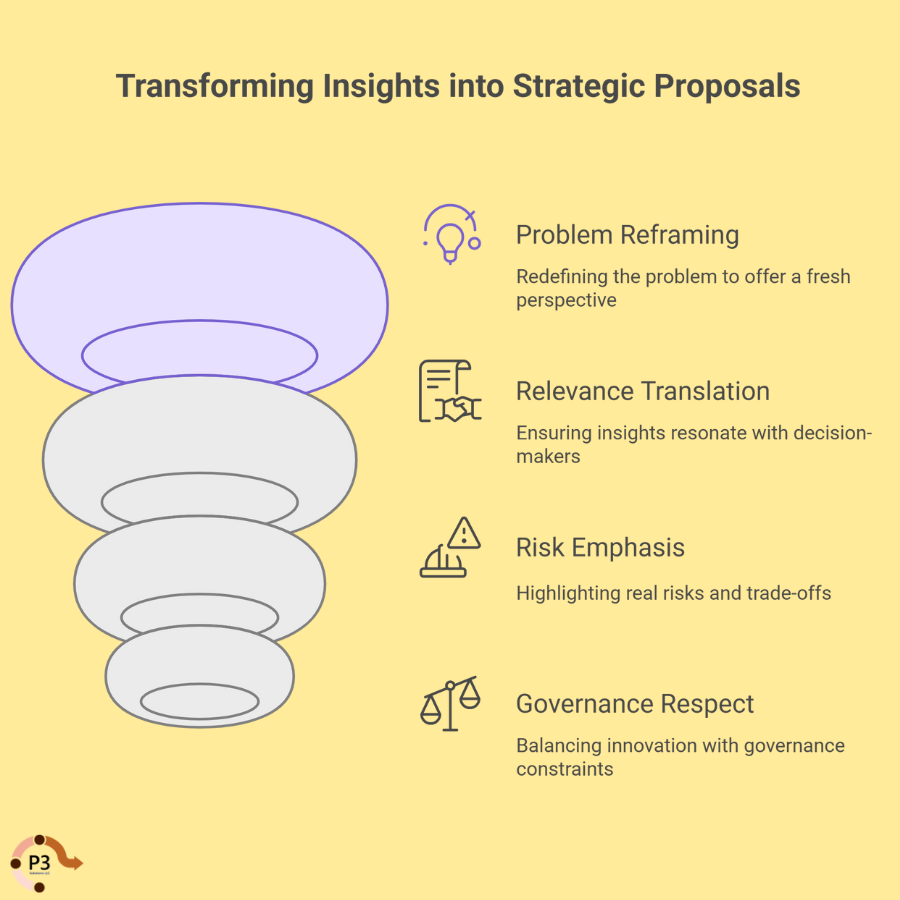
Transforming insights into strategic proposals
If you want real value from insights, then change how the proposal is framed. Discovery sessions, stakeholder interviews, and journey mapping can generate understanding, but proposals must ensure that the experience is a clear, credible strategy that's relevant to decision-makers.
With early definitions shaping downstream decisions, including how options are evaluated and risks are perceived, how the problem is described is critical. Proposals that parrot the RFP's language are doomed to replicate its limitations. Proposals should carefully and credibly reframe the issue so that decision-makers can see the situation more clearly and assess solutions against essential issues, even if these are thornier than most would like.
Journey mapping and stakeholder insights help prioritize issues that could create friction, not just the easy-to-define ones. Experienced leaders tend to use pattern recognition and framing to navigate complexity, which is why journey mapping and stakeholder insights are so critical.
By translating insight into strategy, you can reduce delivery risk. Misframed problems will compound, and the most significant danger is that they will only rear their ugly heads long after the contract has been awarded. Proposals should demonstrate a grounded understanding of operational realities and institutional dynamics, so that all parties have realistic expectations and can deliver.
· Proposal strategy begins with reframing the problem rather than repeating the RFP.
· Insight must be translated into relevance for decision-makers, not more detail.
· Governance constraints can be respected while still challenging assumptions.
· Emphasizing real risks and trade-offs improves credibility.
· Clear problem framing reduces downstream delivery and implementation risk.
Conclusion
Strong proposals don't start with good writing; they start with an intricate understanding of the problem. By relying exclusively on RFPs, teams effectively adopt the limitations of the document, which is ultimately designed for procurement rather than diagnosis. Work will be compliant and polished, but it won't be aligned with the problem that the decision-makers are trying to resolve.
In complex, donor-funded, and public-sector environments, discipline matters. Requirements won't disappear, but they can't overpower clarity, and proposals should respect formal processes and reflect the necessary understanding of context, constraints, and consequences. Work with P3 Solutions at this early and often-overlooked critical stage. We can help teams step back from the documents to see the real problem, creating grounded, credible, and deliverable proposals. The quality of the outcome is decided long before the proposal is submitted. Are you sure you're on the right track?
Further Reading
OECD: Public Procurement for Innovation
Prosci: What Is Change Management?