
Avoiding Change Fatigue: sustaining transformation over time
Written by Joseph Philipson.
Originally published January 29, 2026.
Images have been generated using AI, unless otherwise stated.
Organizations today are obviously under pressure to perform. However, at a certain point, they need to change and adapt to keep up. Research has shown that prolonged exposure to unrelenting demands leads to exhaustion, cynicism, and reduced effectiveness because people have a limit to how much they can deal with change.
Continuous waves of transformation can create a similar dynamic. Employees may end up disengaged or resistant to change, not because they don't want to perform well or work more effectively, but simply because they're exhausted by the volume and overlap of change. Employees are losing patience with constant changes. Let's see how change fatigue develops, how we misdiagnose it, and how leaders can sustain transformation without wearing their employees down.
Why continuous change is wearing organizations down
In the last decade, how organizations change has shifted from episodic to continuous. Change itself is constantly changing, and what was once a clear program with a beginning and an end is now a constant reinvention. The strive to become agile and reactive across industries has a human cost, and it's the same sustained cognitive and emotional demand employees face.
Research on burnout has shown that prolonged exposure to high demands with limited recovery time will lead to exhaustion and disengagement, not improved performance. This isn't to say that employees will refuse to comply with new initiatives, but they'll have less energy and attention and likely not really believe in the value of the changes.
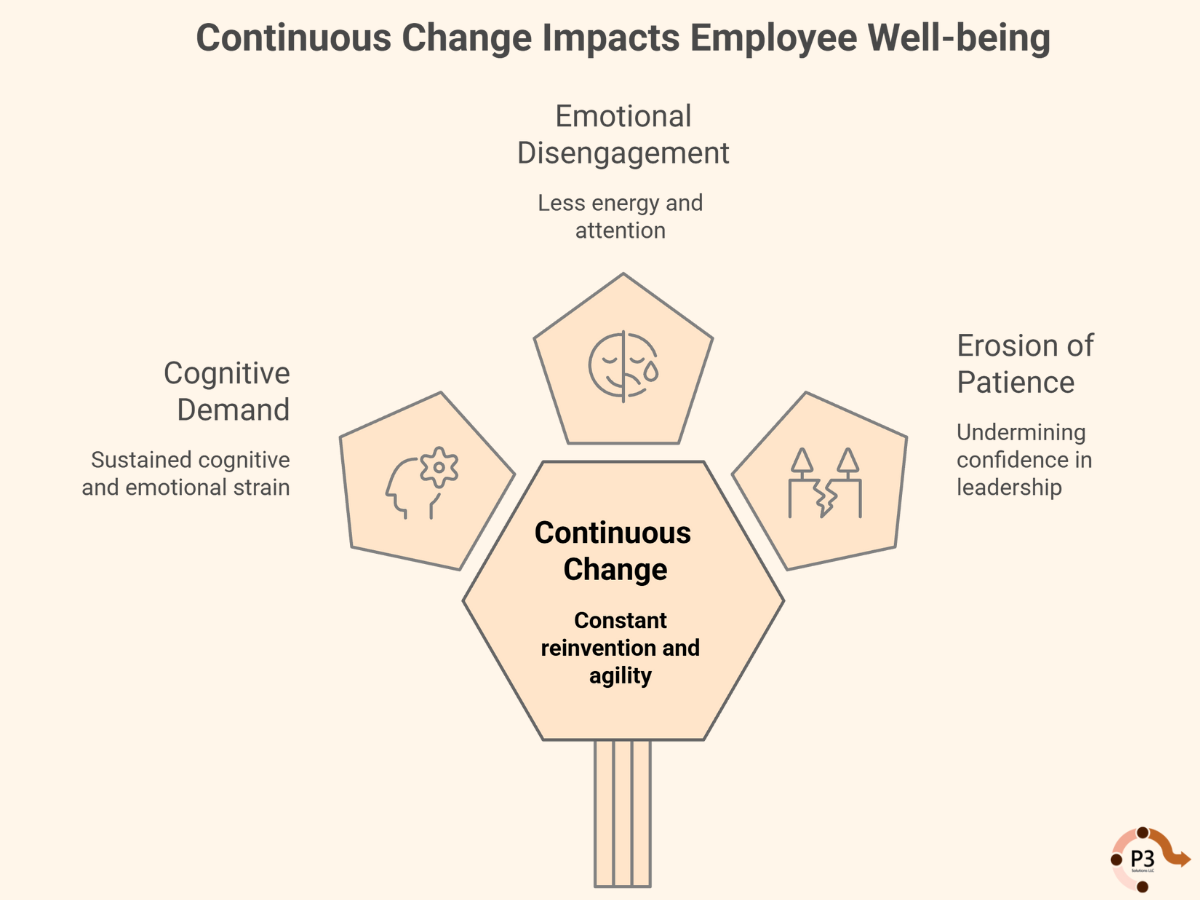
Continuous change impacts employee well-being
Continuous change has a cumulative effect. Frequency and amplitude both affect how much change is felt. Overload and a lack of perceived control are key contributors to long-term fatigue and professional efficacy. Individual changes may seem manageable in isolation, but when strung together and never-ending, there's a persistent sense of pressure and unfinished work.
Leadership research backs this up. Large organizations are finding that employees experience numerous planned changes each year, many of which overlap and compete for attention. This constant churn erodes employee patience, undermining confidence in leadership intent, especially when initiatives are introduced faster than they can be absorbed. Change doesn't always accelerate progress. Constant change slows it down, with people conserving energy, disengaging emotionally, and just riding out the current change, knowing a new initiative will replace it soon enough.
When too much change happens at once
The strain of continuous change is particularly evident when organizations try to do too much at once. Take our beloved Wendy, our industrious squirrel, and stand-in for bad workplace practices. Perhaps she's been promoted beyond her abilities (our bad), but she now has a middle-management role.
Like when she's gathering nuts for the winter, she's also well-intentioned and highly motivated in her professional life, too. She's launched several transformation efforts simultaneously, including a new operating model, a digital platform rollout, revised performance metrics, and a cultural initiative. Way to go, Wendy, you're really on the ball!
However, she's positioned these as urgent and non-negotiable. With every program and new idea critical to the organization's future, every employee is juggling these initiatives, choosing which ones take precedence, and that results in everybody going in different directions. The employees (and managers) are confused and overloaded.
A single initiative doesn't cause change fatigue; good employees can handle change. However, the cumulative effect and overlapping remit of initiatives have a greater impact than they would individually. Call it change saturation, where the volume of change exceeds an organization's capacity to absorb it. The result is stress, resistance, and declining adoption rates.
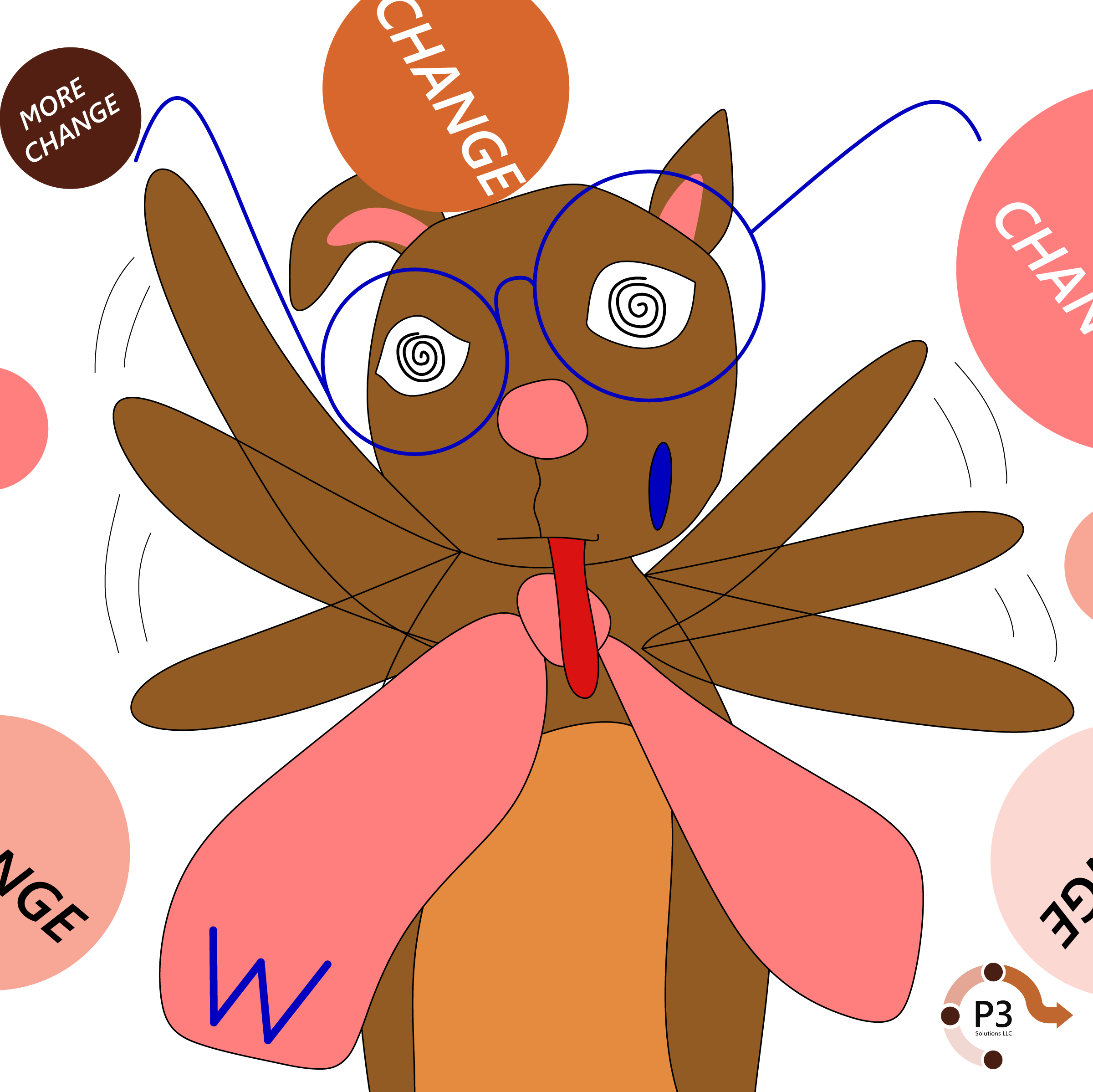
Wendy spinning too many “change wheels” at once. Image courtesy of Hadi Madwar.
So, what can Wendy do about it? For one, she shouldn't assume that her employees are inherently resistant to change. They're just struggling to juggle all these changes. In addition to the sheer number of them, they don't have the time or clarity to see any of them through.
Though we've been giving Wendy all the flak, many modern organizations are guilty of this too. Serial and simultaneous transformations are like running on a treadmill that's speeding up; you're supposed to be going faster, but you're starting to tire, and there's no way to get off. Too many initiatives, all launched at once (or in quick succession), leave employees struggling for survival rather than doing a good job. They may never fully commit to an initiative if they think it will be changed or undone in the near future.
How overlapping initiatives undermine trust and adoption
The overlap is the real killer. The damage from overlapping initiatives is felt beyond just workload and fatigue. These can really erode employee trust, with employees doubting whether the "next big change" will be rolled back, replaced, or just forgotten. Nobody wants to invest in the new initiative and break their back to see it through if it won't even matter next month or next quarter.
Overlapping initiatives can also hurt accountability. With so many different programs or initiatives, who's responsible for each can become unclear or even contradictory. Which change is most important? What metrics are we using for success? How can I get on with my job?
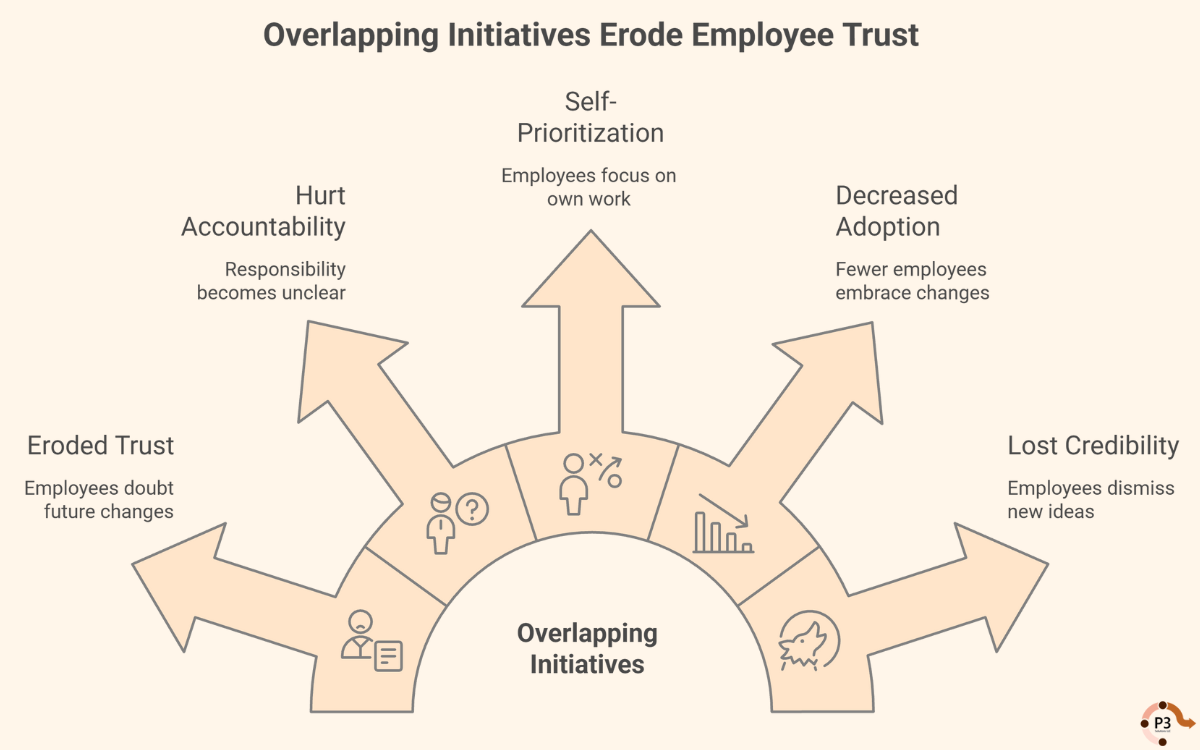
Overlapping initiatives erode employee trust
Employees may self-prioritize, too. They'll look to get their work done, leaving the new initiative to somebody else, riding their luck in the hope that the unfinished work will go unnoticed because it won't even matter when a new initiative supplants this one. This decrease in adoption rates is a clear symptom of change fatigue, because people don't have unlimited capacity to integrate new ways of working, and even less so when they've lost faith in management's ability to implement sustainable, valuable initiatives. The problem really gets bad when management misdiagnoses change fatigue as employees being awkward or just naturally resistant to change.
Again, the long-term impact on credibility is far worse than a single initiative being undersubscribed or undervalued. A classic "boy who cried wolf" effect can occur if management constantly tells employees that new initiatives are high priority, only to undo them in the near future. Employees will be thinking, "Here we go again!" with every new initiative, and one day, when management actually implements a sustainable, valuable new idea, adoption and enthusiasm will be so low that it could struggle to get off the ground.
Most importantly, trust isn't lost because the employees don't like change; it's because they don't believe the organization will follow through!
Why pacing and sequencing matter more than speed
Reactivity is central to almost every industry. No organization wants to fall behind. It's so easy to fall into the trap of moving faster to stay responsive: more initiatives, shorter timelines, and increased urgency.
Speed on its own isn't a substitute for progress. Pacing and sequencing changes will determine whether the transformation actually sticks. You can't rush anywhere if you don't really know where you're going. Even worse, moving quickly can look like momentum, and by the time you realize it isn't, it's too late!
Pacing is critical because employees don't experience changes as independent projects; they feel them as continuous demands on top of their current responsibilities. When changes arrive faster than people can absorb them, employees learn more slowly, and they may resort to taking shortcuts to "more or less" get the job done.
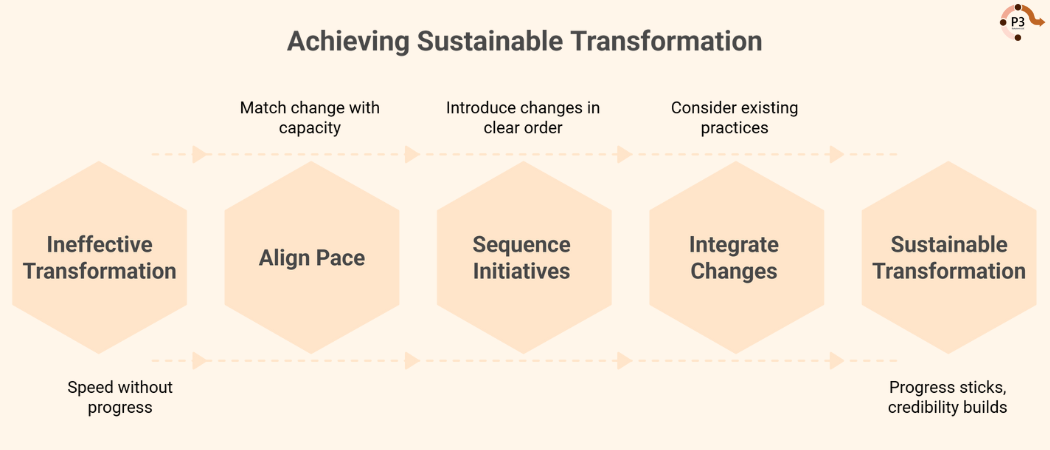
Achieving sustainable transformation
Compliance is only surface-level, and nobody is meaningfully adopting new ideas. Modern transformation efforts tend to fail because organizations underestimate the time required for people to adapt behaviors, systems, and ways of working sustainably.
Sequencing is important, too. Initiatives and changes have to be introduced in a clear order. Compatibility is also key, as dependencies need to be established to avoid contradictions. What happens when employees adopt new tools before processes stabilize? What about embracing new cultural values when the incentive structure will still reward the old behaviors?
Employees will make trade-offs that leadership hadn't addressed or foresaw. Change resilience requires clarity around priorities, timing, and what comes first. New initiatives don't exist in a vacuum; they need to integrate them into the current ecosystem, with full consideration of existing practices and other new ideas.
Sustainable transformation isn't just slowing down. You have to align the pace of change with human capacity, remembering that every employee isn't just adapting to one particular change. Organizations have to deliberately sequence change, allowing space for learning and reinforcing credibility by finishing what they start. Speed doesn't equal effectiveness, and organizations that fall into this trap will repeat the same transformations in new forms and wonder why they never seem to progress.
Using milestones and quick wins to restore momentum
Without clear progress, transformation efforts will lose energy. Large-scale change often promises long-term benefits, but there have to be visible markers along the way. Employees need to see that their efforts are making a difference. If they don't, motivation will decline.
Milestones can break new initiatives into meaningful stages. Employees can recognize progress and strive for it. Don't confuse these milestones with high-level roadmaps; milestones turn strategy into tangible progress points. Teams can see what "done" looks like for each phase, with natural stopping points for pause and reflection. Sustained effort needs periodic psychological closure; else employees will end up with a growing backlog of unfinished change and feel that nothing is ever truly implemented.
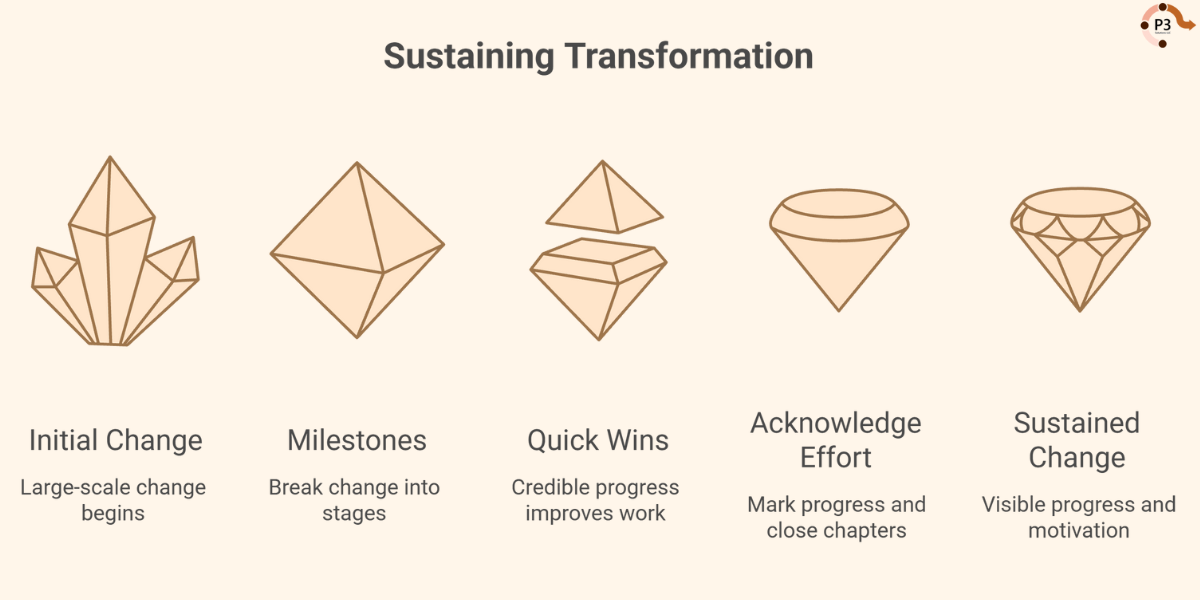
Sustaining transformation
Quick wins can help, but they need to feel credible. Symbolic or superficial wins can help with short-term enthusiasm, but they don't rebuild trust. Focus on progress that improves daily work and demonstrably solves a problem people care about. New initiatives have to be shown to deliver practical benefits, not just add to the workload.
Breaking transformation into milestones and quick wins doesn't mean that you're lowering ambition. These are about making visible and achievable progress. Leaders should constantly mark progress, acknowledge effort, and close chapters before opening new ones. They can reinforce the belief that change is purposeful. Over time, this can rebuild confidence lost from change fatigue or stop it from ever happening in the first place.
Preventing change fatigue starts with leadership discipline.
Employees experience change fatigue, but it's created upstream by leadership. Don't confuse it with a poor attitude or a low resilience to change. Leadership decisions about what to introduce, when, and how much at once are all the culprits. Discipline at the leadership level can prevent change fatigue by treating organizational capacity as a finite resource. Organizations can't absorb every new idea, priority, or strategic pivot, no matter how much leadership wants it.
A common blind spot is forgetting that the load builds up. It's easy to approve new initiatives in isolation, weighing up each's pros and cons. However, they need to be considered alongside other programs. Is it too much all at once? Are we constantly changing things?
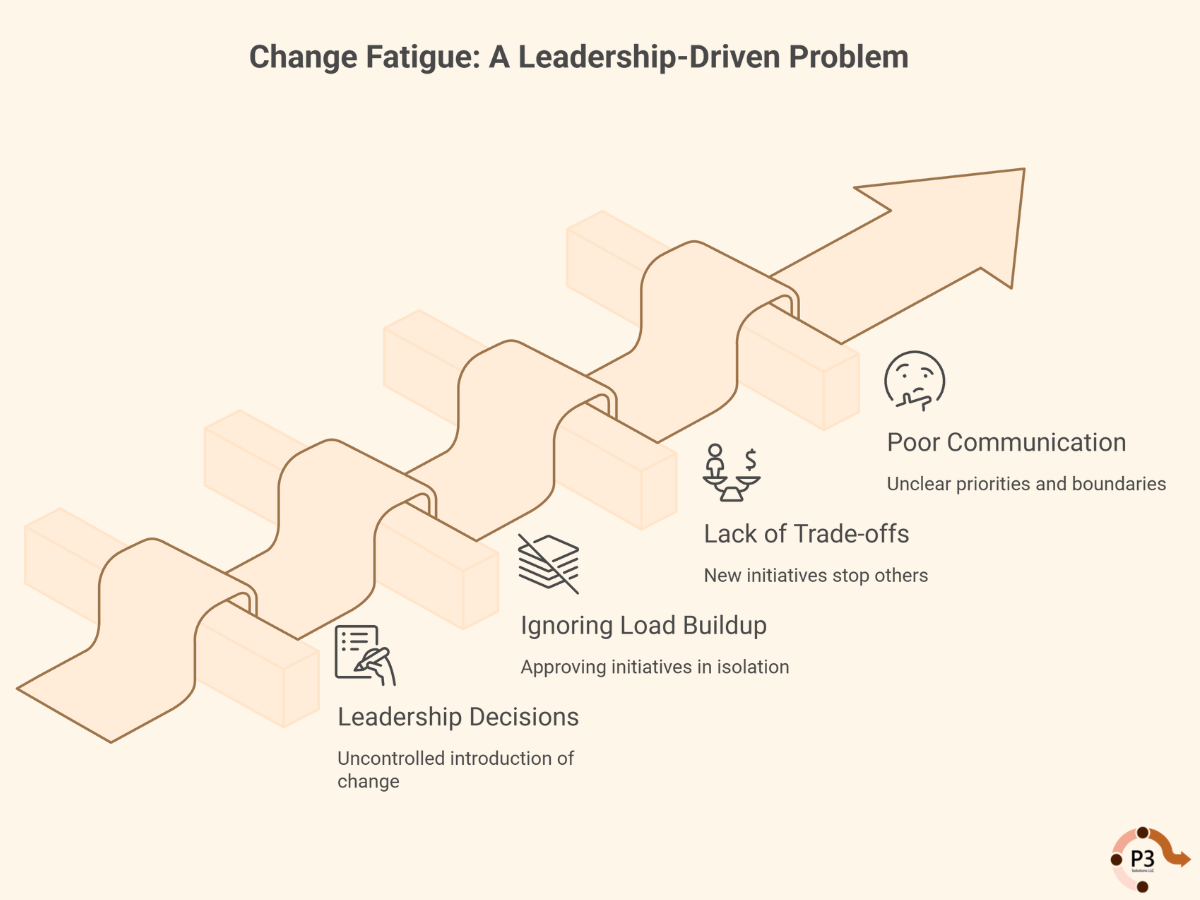
Change fatigue: a leadership-driven problem
Over time, the change builds into a backlog that demands attention and energy, which everybody has finite amounts of. Explicitly evaluating how much change organizations can sustain and adjusting plans accordingly is central to managing change resilience.
Make deliberate trade-offs. New initiatives need to know what will stop, slow down, or be deprioritized as a result of the change. If leadership can't answer this question, the initiative isn't ready for implementation. If they implement it anyway, then employees will answer these questions for leadership, and leadership mightn't always get the answer they want.
Communication, as always, plays a key role. This isn't about motivational messaging or constant updates; it's about giving people clear priorities and boundaries. Leadership has to be explicit about what is changing, what isn't, and what will remain stable despite the transformation. Clarity and consistency are central to maintaining engagement during sustained change, especially for organizations operating near saturation.
Sustaining transformation without burning people out
Now it's time to talk about the b-word. It's easy for organizations to pat themselves on the back for all the new initiatives they've launched and how quickly plans are executed. In reality, they should be focused on what actually endures: initiatives that have stood the test of time and teams that continue to deliver results.
Performance deteriorates when people aren't given time to consolidate learning and regain energy. Allow space between major shifts. Don't launch a new initiative just as one finishes; new ideas should be given the time and space to bed in. Organizations that are constantly moving will actually find that they're not going as quickly as they thought.
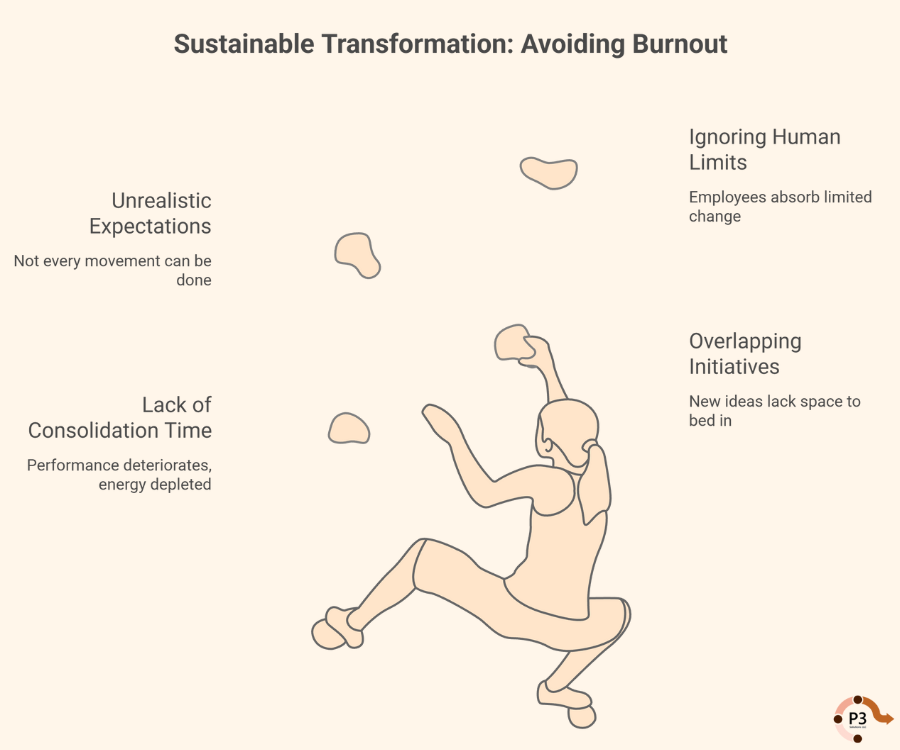
Sustainable transformation: avoiding burnout
Sustainable transformation is built on realistic expectations. Not every movement can be done at once, and sometimes, you have to say "no" or at least put the next big idea on hold until previous initiatives have coalesced.
Avoiding change fatigue doesn't mean that you slow down progress or lower expectations. By respecting human limits for change, you can pursue organizational goals. Leaders need to design change around the fact that employees have a limit to how much change they can absorb at once. Transformation is something that employees participate in. Organizations can evolve without exhausting the people they rely on to make the change.
Need help with your organization? Contact P3 today to see how we can help your organization avoid change fatigue.
Further Reading:
Organizational transformation: Is your organization ready for transformation?