
What Happens When Donors Walk Away
Written by Joseph Philipson.
Originally published November 11, 2025.
All images have been generated using AI.
In the nonprofit and development ecosystem, funding partnerships can have ripple effects when donors step away. A local NGO can scale with a well-structured grant, but the foundations can crumble if a donor withdraws abruptly or without adequate transition. The paradox is that donors can provide catalytic support while also underestimating just how embedded their presence is in the system.
The Partnership Paradox: Powerful and Fragile
Funding partnerships are a relatively simple premise: a donor provides resources, an implementer delivers outcomes, and the beneficiary receives the impact. While funding partnerships appear as a triangle on paper (the strongest shape), they come with inherent vulnerabilities.
Donors hold structural power, such as the ability to decide when support begins, how long it lasts, and why it ends. Generally, they're the actors in this triangle who can "walk away". Implementers and the communities they serve are the ones who manage the fallout when this happens, and even a gradual withdrawal can destabilize systems, especially when built with continuity in mind.
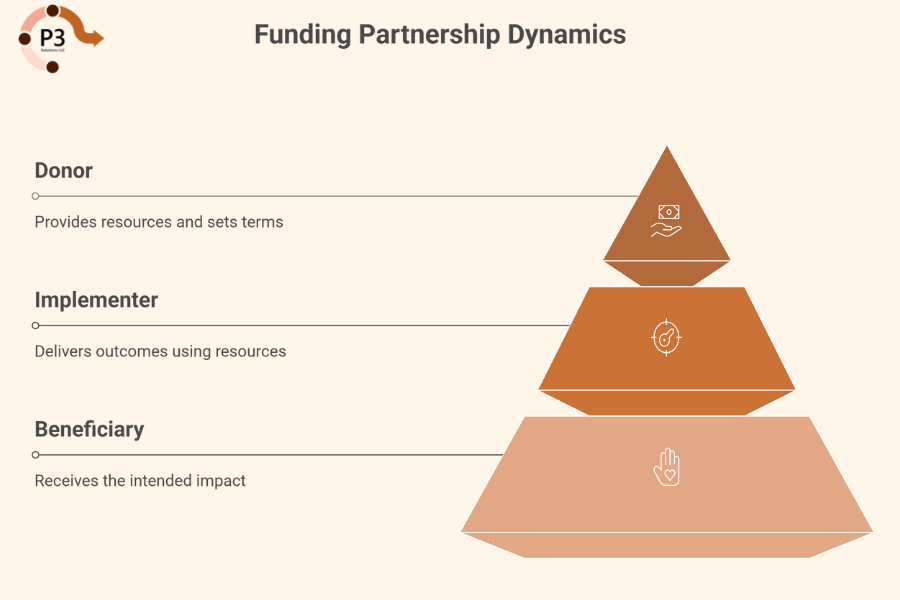
Funding Partnership Dynamics
For example, when the UK's aid reductions moved from a statutory target of 0.7% of GNI to 0.05% it involved “had to make compromises and take difficult decisions across all of its programs”.
At P3 Solutions, we help NGOs and donors analyze power asymmetries in funding partnerships and build strategies that balance accountability with long-term sustainability.
Shockwaves of a Withdrawal
When funding stops, it's the operational level that feels it first. Salaries, supplies, and services are all affected, and there are aftershocks that affect governance, trust, and even regional stability.
The USAID Office of Inspector General's advisory made this abundantly clear during an 85-day pause on foreign assistance.
“executed and planned personnel actions would remove, temporarily or permanently, approximately 90 percent of BHA’s worldwide workforce” and that “USAID’s existing oversight controls […] are now largely nonoperational.”
The uncertainty meant that over $489 million in food assistance at ports, in transit, and in warehouses was at risk of spoilage, with over 500,000 metric tons of food at sea or ready to be shipped.
The health sector experiences similar outcomes when external incentives are removed. For example, experimental evidence from Zambia shows that staff attendance and on-the-job effort declined once a performance-based financing pilot ended.
You can see in Gavi's 2021-2025 Mid-Term Evaluation just how fragile immunization systems become as external support tapers off. The Gavi 5.0 Mid-Term Evaluation shows that progress began to plateau even before the pandemic, warning that long-term sustainability cannot be assume.
“Coverage in some Gavi-eligible countries had been flatlining for some years before dropping in 2020–21, pointing to systemic challenges that pre-dated and are likely to outlive the pandemic. ”
Basically, transitions can unravel without careful sequencing and co-financing arrangements. Handing off other responsibilities won't necessarily guarantee resilience. Even if a program avoids outright collapse, a sudden donor retreat can echo for years. Without clear sequencing, local ministries may have to scramble to fill budget shortfalls and end up relying on new, sometimes less accountable partners.
NGOs on the receiving end can have structural vulnerabilities exposed. With many organizations operationally dependent on one or two large funders, program continuity can collapse when these funders pause or withdraw. You can mitigate this kind of fragility, but only if you build it in long before a donor exits.
P3 Solutions’ Organizational Development advisory work strengthens financial systems, governance frameworks, and exit planning, ensuring NGOs remain resilient during funding transitions.
When Donors Underestimate Their Own Gravity
For donors, ending a funding partnership might be a rational decision following the maturation of a project, fiscal pressures at home, or a policy shift that shifts focus. That UK aid reduction we mentioned earlier came with increased risks to value for money due to choices being made at speed. With limited consultation and incomplete impact analysis, the National Audit Office explained it as:
“FCDO’s initial allocations were completed quickly. As a consequence, it did not complete a thorough review of the impact on outcomes or long-term value for money ahead of high-level allocations.”
Programs were cut or closed mid-cycle, and relationships with delivery partners ended up strained because the system lost predictability.
After allegations against a small number of staff, multiple governments suspended contributions to UNRWA. During the gap, morale and operations were weakened. The agency warned that lifeline services could end.
What might be a budget line adjustment in London, Washington, or Berlin, could unravel delivery chains, workforce plans, and community trust elsewhere in the world. Predictability and accountability go hand in hand, and when the latter vanishes, programs can quickly destabilize.
Case Files: When Funding Disappears
Across continents and sectors, we can see how sudden pauses and cuts strand shipments, close schools, stop clinics, and weaken public trust in aid. Here are just a few examples that are worth looking at.
1) USAID humanitarian oversight during the 2025 pause (United States)
In February 2025, the USAID Office of Inspector General issued an advisory describing how staffing reductions and a government-ordered pause on foreign assistance degraded the agency's ability to monitor humanitarian programs. The alert explains that regular oversight became difficult to implement and details large volumes of food aid stuck in transit or in storage, heightening the risk of spoilage and diversion.
2) UNRWA funding suspensions and service disruption (Middle East)
On January 27, 2024, UNRWA warned that “lifesaving aid may end due to funding suspension,” after several governments temporarily halted contributions. The agency said the decisions threatened ongoing humanitarian work for millions of registered refugees, with knock-on effects for schools, food distribution, and clinics in Gaza, the West Bank, Lebanon, Syria, and Jordan.
3) UK ODA cuts and value-for-money risks (United Kingdom, global partners)
The UK's reduction of Official Development Assistance from 0.7% to 0.5% of GNI led to rapid, mid-cycle reallocations and program closures. The National Audit Office concluded that making multibillion-pound allocation decisions at speed "increased risks to value for money" with limited time to consult delivery partners or fully assess impacts on outcomes.
4) PEPFAR uncertainty and projected health impacts (Sub-Saharan Africa and beyond)
Peer-reviewed modelling in The Lancet: eClinicalMedicine assessed scenarios of funding cessation for PEPFAR, concluding that sudden cuts would have "immediate and far-reaching impact", likely resulting in tens of thousands of excess HIV deaths and many additional infections if support were not restored.
Should Donors “See It Through”?
Donors may ask themselves, "How long is long enough?" They rarely want to create dependencies, but withdrawal can highlight an ecosystem's dependencies. We have to wonder whether the donors have a responsibility to leave ethically. After all, they certainly have the right to go and are under no obligation to continue donating forever, but there are ethical concerns.
We should see development aid as temporary scaffolding that supports national systems until they can stand on their own. However, if removed too soon, scaffolding can leave any project in a worse state than before it was put up. The damage that poorly planned transitions cause can undo years of work, and the knock-on effects of eroded confidence only exacerbate the problem.
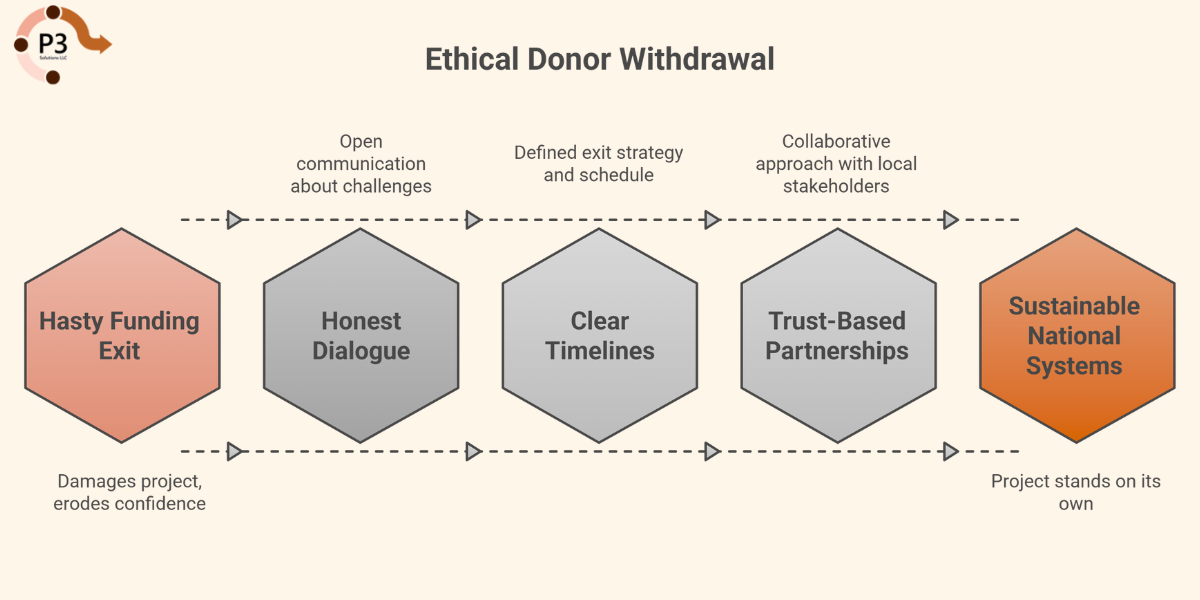
Ethical Donor Withdrawal
The moral dimension is that donors will likely have been claiming credit for the progress their funding has enabled, but they'll likely downplay the ultimate damage a hasty funding exit could cause. No donor can fund indefinitely, but they should claim ownership for their stewardship of anything that they're funding, for better or worse. There needs to be honest dialogue, clear timelines, and trust-based partnerships.
At P3 Solutions, we work with donors and implementing partners to embed ethical accountability into exit and transition planning. Responsible withdrawal is not just good governance; it's a good partnership.
Designing Responsible Exits
Donors should frame exits as transitions. They can retain credibility and create space for local actors to lead. Transition success depends on early planning and predictable financing. Exit strategies should be integrated from inception, with clear milestones, domestic co-financing targets, and risk assessments to ensure institutional continuity. Thus, governments and NGOs can assume funding responsibilities gradually rather than abruptly, enabling better decision-making.
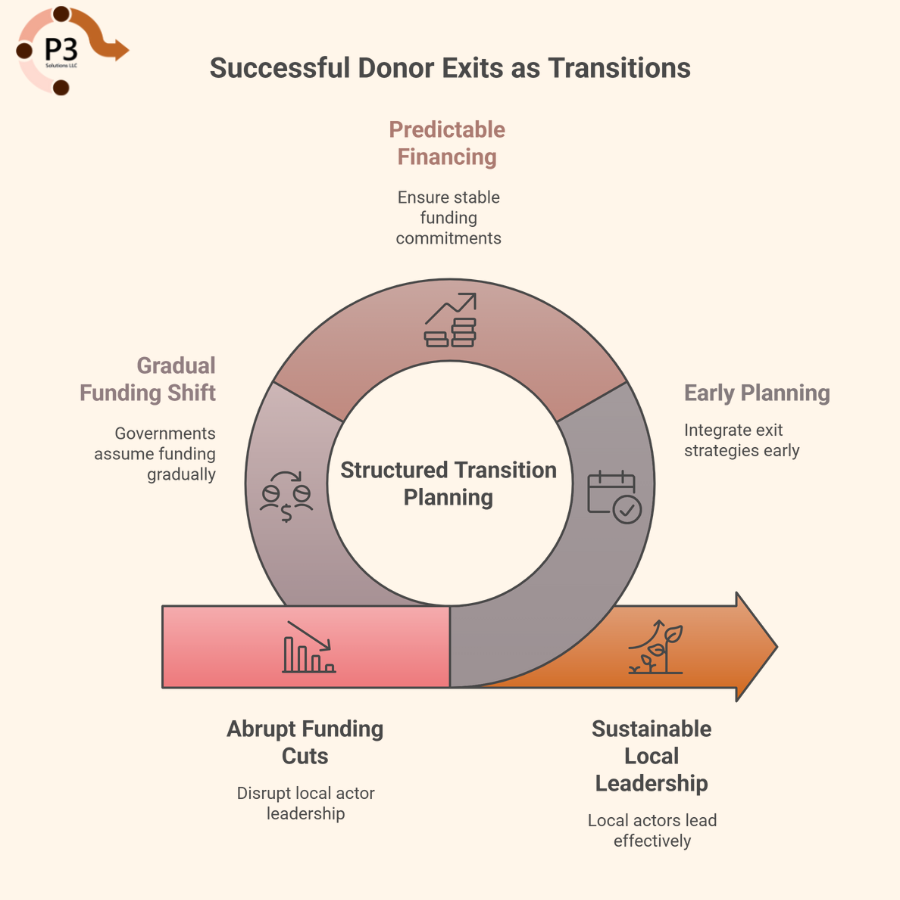
Successful Donor Exits as Transitions
The Gavi transition model is a good example of structured planning. Countries begin preparing for transition once they cross an income threshold with multi-year co-financing arrangements and technical support for procurement and data systems. With the process lasting between five and ten years, when external subsidies end, vaccine coverage won't collapse.
What NGOs Can Do Now
If a withdrawal is inevitable, NGOs must be prepared. Donors may control funding, but NGOs can take steps to ensure readiness. This can be through systems and relationships that determine how they weather a funding shock.
Map donor concentration and financial exposure: Every NGO should know precisely how dependent it is on its top three donors. Creating a donor-dependency matrix, identifying exposure, timelines, and renewal likelihood, is the first step in managing risk rather than reacting to it.
Negotiate exit clauses early: Memoranda of Understanding or grant agreements should include explicit transition and communication clauses that spell out notification periods, co-financing expectations, and data-handover procedures.
Build diversified revenue streams: Diversification isn’t only about new donors; it also includes service contracts, membership models, and locally generated income. Social-enterprise components and fee-for-service activities, when aligned with mission, can smooth cash flow and sustain programs between grants.
Strengthen internal systems before they are tested: Sound governance, transparent accounting, and digital reporting systems aren’t bureaucratic luxuries; they're tools for survival. During donor transitions, organizations with verifiable financial controls and clean audit trails are far likelier to attract bridging support or replacement partners.
Maintain transparency with communities: When funding changes, honesty matters. Informing local partners, beneficiaries, and staff early about financial uncertainty builds trust and invites collaboration in finding solutions. Concealing risk erodes the very social capital NGOs depend on.
Collaborate rather than compete: Pooling procurement, sharing staff training, or jointly bidding for successor grants can turn competition into collective insurance. Small organizations that form consortia during donor exits are more likely to sustain operations than those that act alone.
Further Reading:
The Invisible Link: Donor Agencies, Taxpayer Money, and Public Accountability
The Shrinking Grant Pool: Why NGOs Must Now Compete Like Businesses
When Proposals Become Pitches: Rethinking the Purpose of Grant Applications
Competing Without Losing Your Soul: What Does 'Winning' Look Like in the Nonprofit Sector?