Time Management Strategies: working efficiently
Written by Joseph Philipson.
Originally published November 18, 2024.
Part three of our five-part series on time management strategies.
All images are P3 originals, courtesy of Hadi Madwar.
Working efficiently
Time management is essential for getting tasks completed on time, living healthily, and maintaining a good work-life balance.
In previous articles, we've seen how to prioritize tasks and how to plan them. Now that you know what to do and when to do it, it's actually time to get things done.
Here's how to work efficiently to make the most out of your time.
You've meticulously planned your day so now it's time to actually do some work.
But how can you get it done as effectively as possible?
These are some of the common and most effective techniques to make the most of your time.
Complete tasks in batches
If you have several tasks to complete that all involve a similar activity, do these in batches. Certain repetitive tasks can be completed much more quickly if you do them all at the same time and reach a flow state. A flow state is a mental state of complete focus and immersion in a task, often accompanied by a feeling of energized focus, full involvement, and enjoyment in the process of the activity.
For example, if you regularly print things, block out a printing time as part of your time blocking, and print everything you need simultaneously.
The time blocking we talked about in the previous article will help to ensure you stick to certain tasks, but even within high-priority tasks, there are ways to work more effectively by getting into a repetitive rhythm while you hyperfocus on a single activity.
More specifically, this is called task batching and if you find that you're the kind of person who works effectively on repetitive tasks, use task batching when and where you can.
Typically, task batching is most effective in the morning when we're more awake, but night owls or those who find their rhythm later in the day may want to schedule task batching for later on.
Use a 52/17 rule or Pomodoro technique
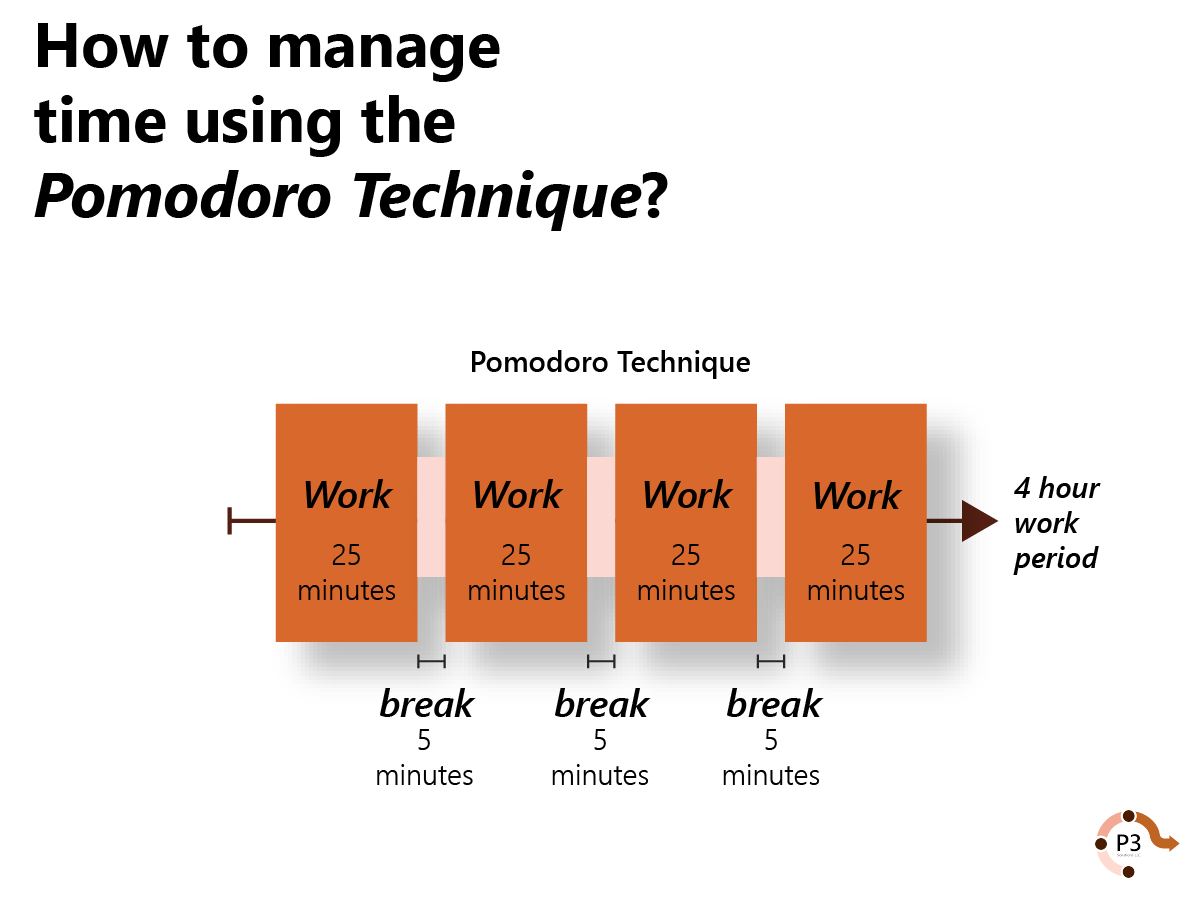
Several time management methods exist, such as the 52/17 Rule and the Pomodoro Technique. They both work in similar ways.
The 52/17 Rule states that you should work continuously for 52 minutes and then rest for 17 minutes.
The Pomodoro Technique is similar, but you work for 25 minutes and then take a 5-minute break. After repeating this process four times, you can take a more extended break (usually 20 to 30 minutes).
The exact amount of time you use will depend on how you work. Some people won't be able to get into a flow in 25 minutes, whereas others will find short bursts of work with regular tiny breaks the most efficient way to work.
The work-break split you decide upon for your work depends on several factors and you can always adjust these “rules” or techniques to suit how you work most effectively, remembering that you can also adjust them according to the task you just completed. For example, after difficult or exhausting tasks, remember to take longer breaks.
Use time management tools and technologies
There are plenty of tools you can use to ensure you're working according to these techniques.
Solutions like Time Doctor allow employers to monitor employees and how they use their time. Time Doctor automatically tracks time, showing how productive you are, how much of your time is spent idle and even notify you with a distraction alert if you've been idle for too long.
Browser extensions like Strict Workflow use the Pomodoro Technique to block distracting websites while you're supposed to be focused! You can choose which websites are blocked when you're working and also set how long work time (indicated by a red tomato) and breaks (a green tomato) are.
If you just need a to-do list, the site and app Todoist is simple and you can use it to set up tasks and satisfyingly check them off once they're complete. You can also add deadlines to every task and setting up tasks is fairly intuitive.
For example, if you type when the task needs to be completed, it will schedule the deadline for then. You don't even need to type dates and you can even put repeating tasks in there by typing expressions like “the first Monday of every month”, “next Wednesday”, etc.
Delegate Tasks
Delegation is important (so much so that we'll likely need another article on it). Remember that it doesn't matter whether you can do something more quickly or better than somebody else if you're wasting your own time by doing it.
Delegating tasks to the right people cannot only free up your time but also ensure that tasks are done efficiently and effectively, contributing to overall productivity.
When you've prioritized tasks to complete, remember to delegate urgent and "unimportant" tasks to the right people.
The best way to work effectively, after all, is by focusing on the tasks you should be doing and not tasks that somebody else should be focused on!
Work when you're most efficient
The adage ‘strike while the iron is hot' applies here. You should know when you're at your best and if you have the flexibility to choose when you get specific tasks done, try to get them done when you're most efficient.
This means identifying your peak productivity hours, when you feel most energized and focused, and scheduling your most important or challenging tasks during these times to maximize your output.
If you can manage when and where you work, do everything you can to complete high-priority tasks when you're full of energy, awake, focused, and ready to tackle anything!
This is probably the most personal of the advice offered and when we cover auditing your time and evaluating your time management, we'll discuss in more detail how to work out when the best time for each task is.
Need help to complete your project on time? P3 Solutions can help!
We thrive on the challenge of creating exceptional written content, provide business development processes to help you stay ahead of the competition, and mission-critical business solutions.
Contact us and tell us how we can help you meet your next challenge.
Further reading:
Rock blog: https://www.rock.so/blog/how-to-work-effectively-and-efficiently
Leaders article: https://leaders.com/articles/productivity/work-efficiency/
Wrike blog: https://www.wrike.com/blog/skills-strategies-boost-work-efficiency/