
Leading Through Uncertainty: Building Leadership Skills
Written by Joseph Philipson.
Originally published April 07, 2026.
Images have been generated using AI, unless otherwise stated.
You can only see real leadership in uncertainty. It's always been part of it. However, now, the pace, visibility, and expectations have changed, and leaders have to respond in real time. Teams are more distributed, communication is less predictable, and the signals that were once central to guided decision-making can't be found or are delayed.
Many leaders still rely on the tried-and-tested approaches with tighter control, more oversight, and clearer plans, which is all well and good until they find themselves in uncertain environments.
How can leaders build the skills to adapt, connect, and guide teams through ambiguity, especially in uncertain hybrid environments?
Why Leadership Feels Harder in a Hybrid, Uncertain World
Leadership has become more complex and less visible. Traditionally, leaders could walk into the room, feel the shifts in the energy, and course-correct. In hybrid settings, it's hard to see these signals; if they're even visible.
The pace of change is different, too. Priorities shift quickly, and information is incomplete, leaving many decisions to be made before the situation is clear. Regardless, leaders have to provide direction while still figuring things out.
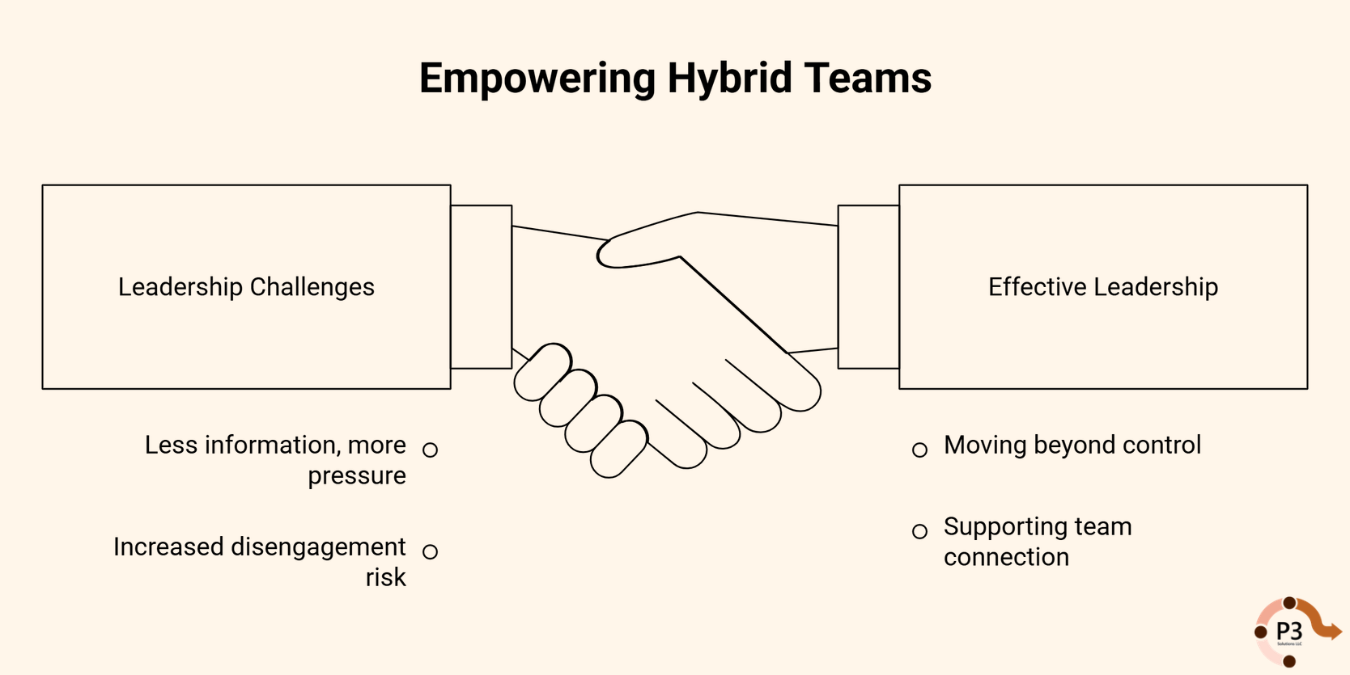
Empowering hybrid teams
This can be tense. Traditional leaders feel they need to tighten control through more check-ins, oversight, and detailed plans. In reality, these are all just hurdles that slow teams down and create frustration. Traditionally strong leadership has evolved into micromanagement.
That said, there's also a lack of regular in-person interaction in many hybrid environments, with leaders struggling to spot disengagement, stress, or confusion. Process and performance metrics don't always reflect what's happening with their teams.
Low visibility and high expectations quickly expose where traditional leadership approaches are lacking.
· Hybrid work reduces visibility, making leadership more complex
· Leaders have to act with less information and more pressure
· Control-based leadership often slows teams instead of supporting them
· Human signals are easier to miss, increasing the risk of disengagement
Where Leaders Struggle: Agility, Empathy, and Trust Gaps
Leadership gaps become more visible in times of uncertainty. This isn't because leaders are less capable; it's just that the environment exposes habits that worked before but no longer do.
Agility is the first place it strikes. Many leaders like working from fixed plans, but hybrid environments require constant adjustment. Leaders can't hesitate when priorities shift, especially if they're waiting for more clarity (it's not coming, by the way; that's just the way things are!). Others go too far the other way, plowing on without bringing their teams with them. In both cases, everybody ends up confused rather than led.
Empathy is another place that feels the strain in uncertainty in hybrid environments. You can't really understand how people are doing when conversations are purely transactional, focused on updates and deliverables. Leaders can easily miss the signs of stress, disengagement, or uncertainty, especially through emails and video calls.
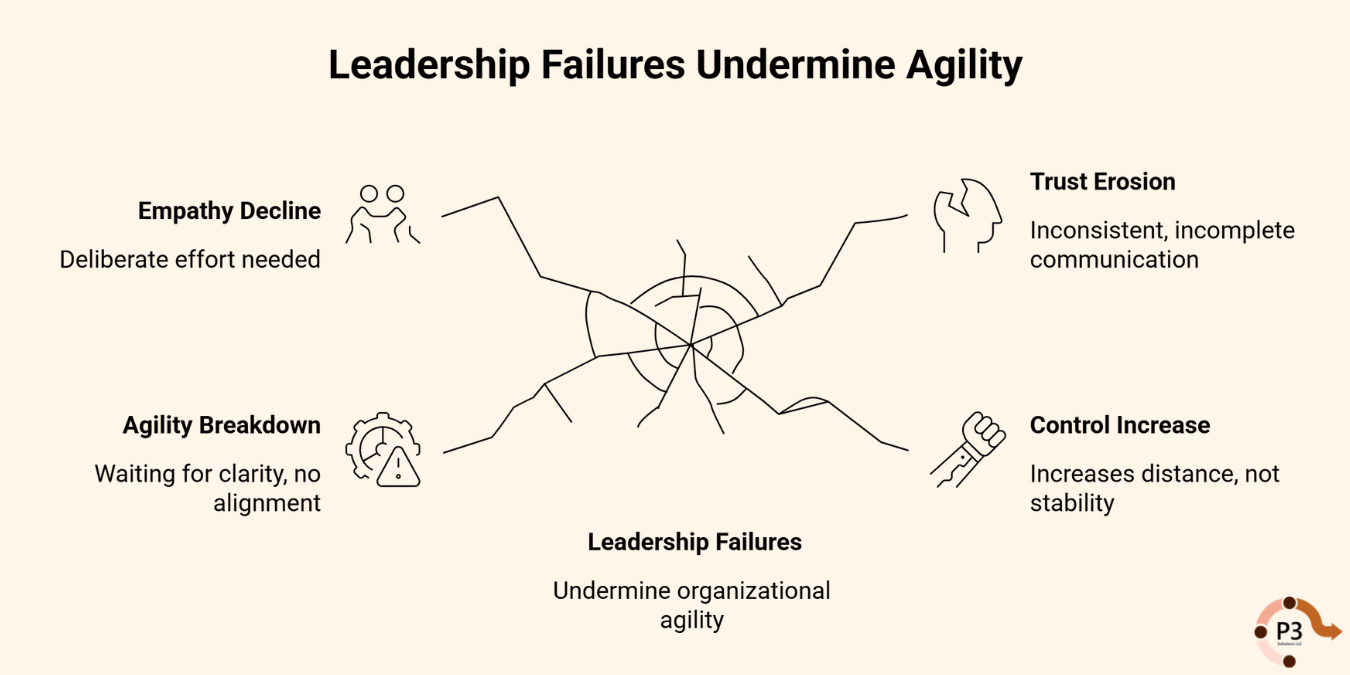
Leadership failures undermine agility
Trust ends up being the last straw. Communication can become inconsistent and unclear, so teams fill in the blanks themselves. When teams and leadership are misaligned, confidence in leadership decisions is reduced, and there's a lot of second-guessing. Even small gaps in communication can erode trust.
Read our series: Poor Communication in the Workplace.
Don't fall into the familiar patterns. Avoid increasing oversight over clarity. Don't focus on outputs over conversations. Acknowledge uncertainty rather than relying on outdated and inappropriate approaches that create distance rather than stability.
· Agility breaks down when leaders wait for perfect clarity or move too quickly without alignment
· Empathy requires deliberate effort in hybrid environments; it doesn't happen by default
· Trust erodes when communication is inconsistent or incomplete
· Control-based responses often increase distance rather than stability
What Not to Do: The Wendy Example
Let's look to our beloved and well-meaning colleague Wendy. We all have a Wendy or two in our organizations, though ours is admittedly a squirrel. Wendy's well-meaning and industrious, like all good squirrels, but she's not a natural leader.
She's in the business of acorn acquisition, where agility is essential. Unfortunately, crisis strikes. During routine acorn collection, she has to outrun a dog in the park. She reacts quickly, changes direction multiple times in a short period, and completely forgets her priorities. She thinks she's being responsive, but she ultimately finds herself up a tree with nowhere to go, hoping that the problem will resolve itself.
Now, she's waiting for a "complete" picture. She can't let anyone else in the loop because she's stuck. Her team? Working without her, busily collecting acorns. They can't get proper answers from her, and in her absence, they're filling in the gaps themselves and plowing on in their own directions. Are they up to date with the latest acorn directives? Hardly, they're collecting whichever ones they can find, looking in the wrong places, and storing them where they think Wendy would want them.
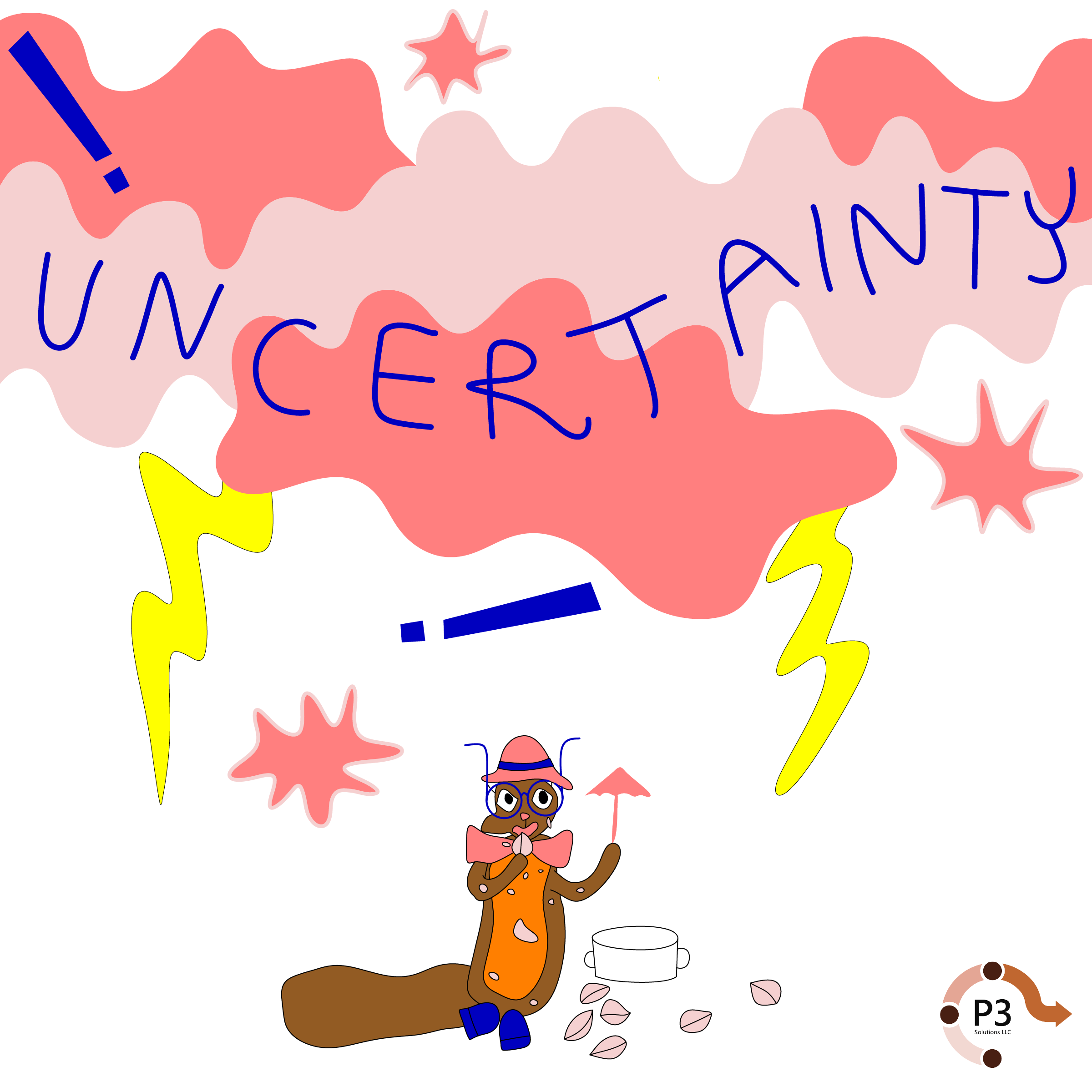
Wendy panicking under “uncertainty” storm clouds
She's stubborn and acts like she knows what she's doing. She won't admit that she isn't sure about the next steps. By this point, the park's full of dogs as all the dog-walkers are here, and Wendy's ended up in a tree, and nobody else knows what to do.
· Constant reaction creates instability, even when intentions are good
· Holding back information increases confusion and misalignment
· Avoiding uncertainty reduces input and weakens decision-making
· Leadership behavior directly shapes how teams experience change
More about Wendy: what NOT to do in the workplace.
The Skills Modern Leaders Need Now
In times of uncertainty, adaptability and connection are the capabilities that good leaders need. Leaders who can adjust quickly, bringing their teams with them, are the ones who'll do best in hybrid settings.
Look to shift how leadership is practiced. Don't rely on certainty; learn to operate effectively without it. Pay close attention to how your teams are experiencing change rather than simply focusing on execution. The two capabilities that stand out are adaptive thinking and emotional intelligence. With these, leaders can respond to shifting conditions while maintaining alignment, trust, and momentum.
Adaptive Thinking: Leading Without All the Answers
Adaptive thinking is making progress without the complete picture. Move forward with the best information available while staying ready to adjust. In practice, this is shorter planning cycles, more frequent reassessment, and a willingness to test and refine rather than wait for the perfect solutions. Adopt this approach, and you can create momentum even when things aren't clear.
This extends to how decisions are communicated as well. Don't see plans as fixed. Frame plans as evolving so that teams can stay flexible without feeling lost.
Emotional Intelligence: Leading People, Not Just Processes
Emotional intelligence is key to keeping people engaged. In hybrid environments, leaders can't rely on proximity to see how their teams are doing. Make sure that you're intentional about listening, communicating, and responding.
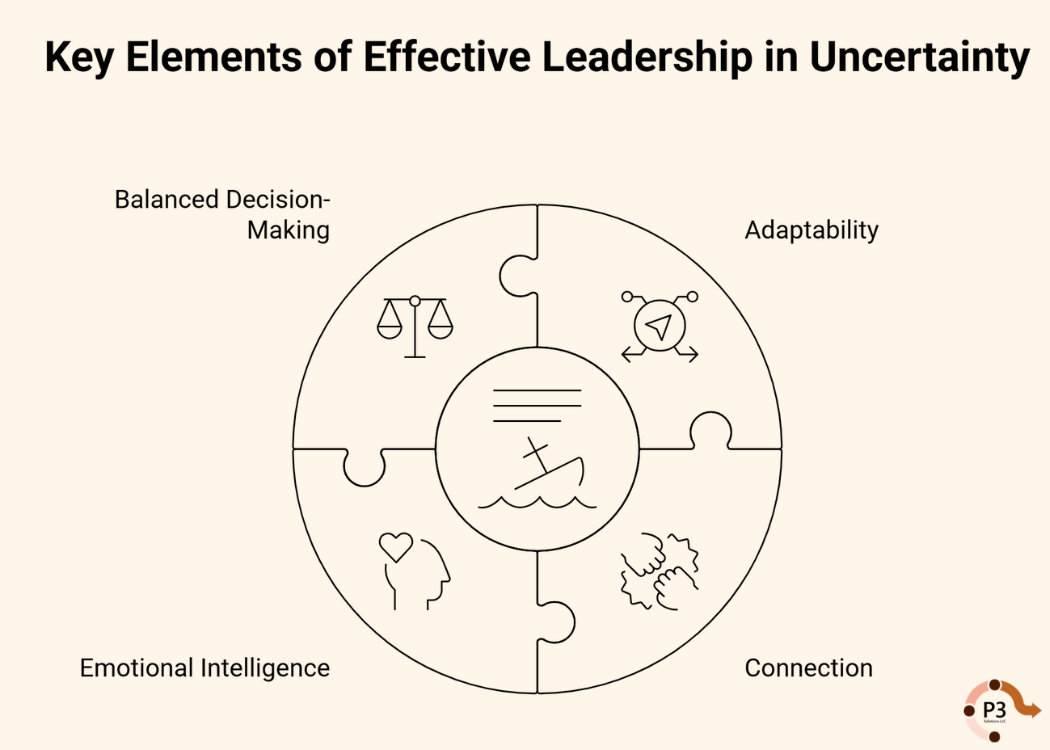
Key elements of effective leadership in uncertainty
Start with self-awareness. Recognize that your own stress can pass that pressure onto your teams. Take the time to understand your team's concerns by asking open questions, listening actively, and maintaining a connection, even at a distance.
· Effective leadership in uncertainty depends on adaptability and connection
· Adaptive thinking enables progress without perfect information
· Emotional intelligence keeps teams engaged and aligned
· Leaders need to balance decision-making with understanding how people experience change
Why Transparency and Vulnerability Build Stronger Teams
People don't expect their leaders to have all the answers. However, they do want their leaders to be clear about what they know, what's changing, and what it means. Without this clarity, teams will assume, and while we all know the saying about assumptions, what that doesn't make clear is that assumptions tend to be negative. The result is increased anxiety, reduced alignment, and slower decision-making.
Address this directly with transparency. Share information early and give teams a clearer picture of what's happening, even if you don't have the full picture. Reduce guesswork so people can focus on what matters. By communicating openly, shifts in direction can feel more intentional than reactive, helping people stay aligned because they understand the context behind decisions.
Be vulnerable. Leaders can acknowledge uncertainty and admit that they don't have all the answers. Others can contribute, bringing their skills and knowledge to the situation. This allows input and decisions to be shaped collaboratively, leveraging the whole team's skills.
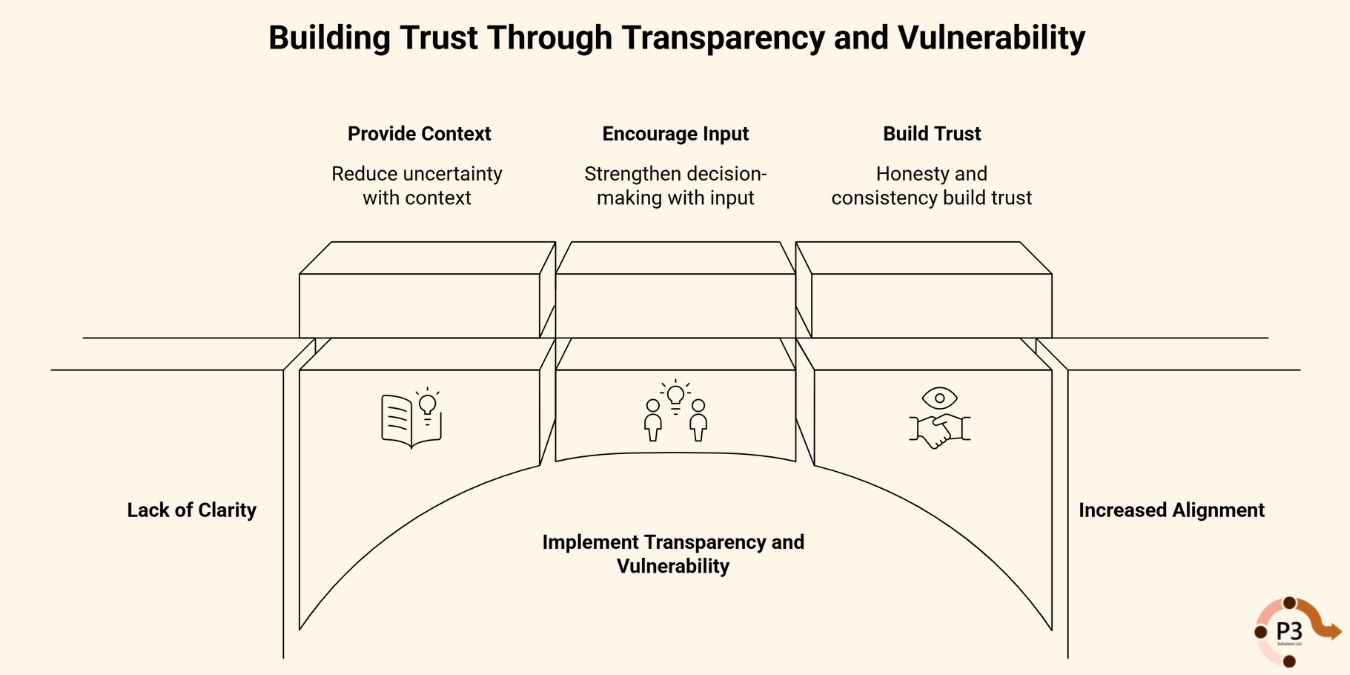
Building trust through transparency and vulnerability
Rather than reducing confidence, this builds credibility. Teams have more ownership and agency, and they trust leaders who are honest about the challenges rather than presenting certainty that clearly doesn't match reality.
· Lack of clarity leads to assumptions, and assumptions reduce alignment
· Transparency reduces uncertainty by providing context, even when information is incomplete
· Vulnerability encourages input and strengthens decision-making
· Trust is built through honesty and consistency, not perceived certainty
Practical Leadership Habits That Work in Uncertainty
To lead through uncertainty, you need to form habits that turn intent into action. The most effective leaders build simple, repeatable practices that combine adaptability with clear communication and strong relationships.
Regular check-ins are an effective tool. These aren't status updates; they're conversations with space for context and concerns. Open-ended questions are a good way to help issues surface early before they snowball into larger problems.
Be flexible. Flexibility needs to be built into your goals. Rigid plans quickly become outdated in uncertain environments. Break work into shorter cycles and revise priorities frequently. Look to focus teams rather than locking them into the wrong direction.
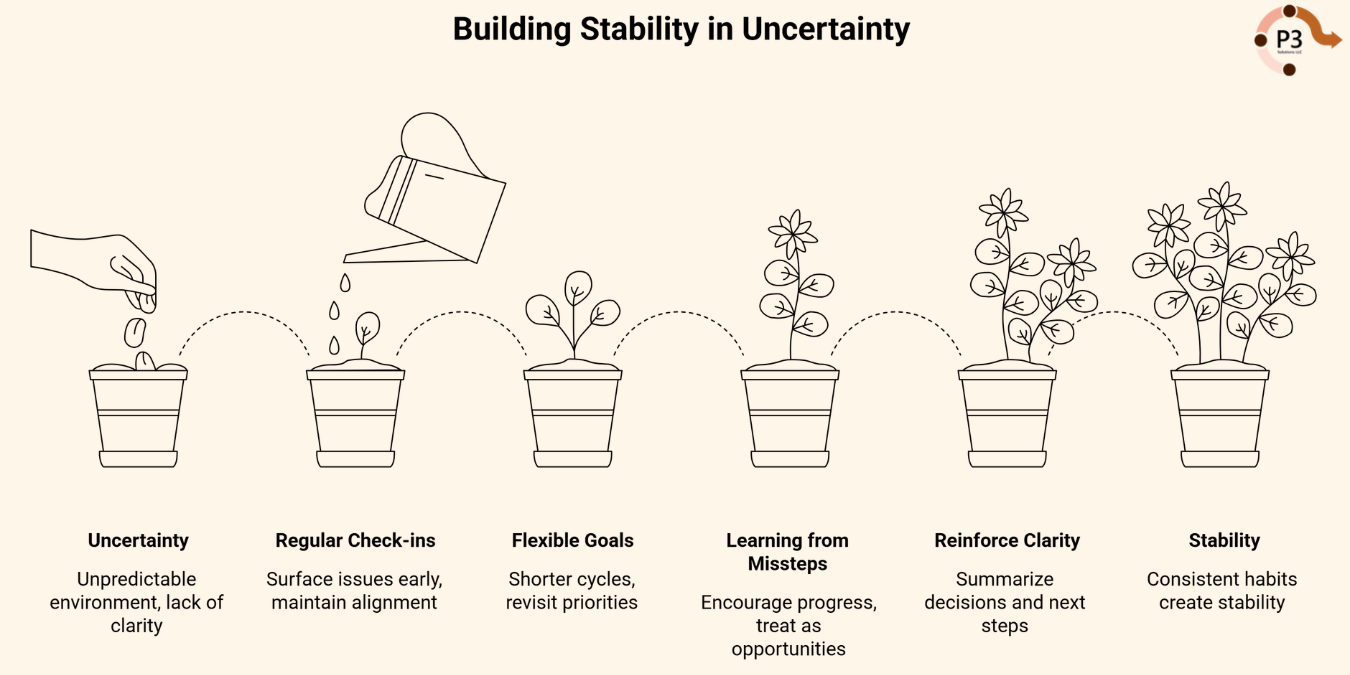
Building stability in uncertainty
Normalize learning, too. With changing conditions, not every decision will work. Treat missteps as learning opportunities rather than failures. Encourage teams to move faster and contribute more openly.
· Use regular check-ins to surface issues early and maintain alignment
· Keep goals flexible by working in shorter cycles and revisiting priorities
· Treat missteps as learning opportunities to encourage progress
· Reinforce clarity by summarizing decisions and next steps
· Consistent leadership habits create stability in uncertain environments
Leading Through Uncertainty Is Now the Job
Uncertainty is the environment in which leaders are operating now. Organizations can move forward when conditions are clear and not because they know everything, but because people are aligned, informed, and responsive.
Leadership isn't about having the right answers; it's about creating the conditions that lead to better decisions. Adaptability, emotional awareness, and transparency are key, even if they may feel uncomfortable at first. Teams that trust their leaders can move faster and handle change more effectively.
Need help leading through uncertainty? Contact us today to see how we can support you.
Further Reading:
How to Talk to Your Team When the Future Is Uncertain: https://hbr.org/2020/04/how-to-talk-to-your-team-when-the-future-is-uncertain.
5 Principles to Guide Adaptive Leadership: https://hbr.org/2020/09/5-principles-to-guide-adaptive-leadership.
Are You Leading Through the Crisis or Managing the Response? https://hbr.org/2020/03/are-you-leading-through-the-crisis-or-managing-the-response.
Leadership in a Crisis: Responding to the Coronavirus Outbreak and Future Challenges: https://www.mckinsey.com/capabilities/people-and-organizational-performance/our-insights/leadership-in-a-crisis-responding-to-the-coronavirus-outbreak-and-future-challenges.