
The Dangers of Poor Writing in Workplace Communication
Written by Joseph Philipson.
Originally published June 18, 2025.
Part four of our five-part series on poor communication.
All images are courtesy of the P3 team.
Recently, we have discussed subpar and sometimes dangerous workplace communication, the issues it can cause, and the money it can cost. Now, we have to look at the problems of poor writing.
With so many parts of modern workplace communication being digital, like emails, messages, or reports, writing has to be a key skill. With remote and hybrid working and even employees in different offices, much of their communication is written.
So, how does poor writing affect organizations? What constitutes poor writing? And what can organizations even do about it?
When workplace writing goes wrong
Writing feels so routine for most modern workers that they hardly count it as a skill; instead, it is a given. However, with one unclear sentence, a poorly chosen word, or a badly structured email, you can end up with relationships damaged, progress stalled, and, most importantly, money squandered.
Many of you will have seen this kind of “bad” writing.
Perhaps an email subject line failed to convey the urgency of the content and ended up buried in somebody's inbox, or perhaps the content was far too "chatty" and took a lifetime to read.
Conversely, a curt message might seem rude, giving the impression that the writer is angry at the recipient or unreasonable.
Then, some reports will either be full of excellent and helpful insights or full of jargon because somebody wants to sound like the authority on a given topic.
When written communication occurs more often than face-to-face interactions, these issues worsen because tone and facial cues are absent from the conversation. Recipients cannot immediately clarify the message, which means misunderstandings are left to linger. They misunderstand the message's original intent, and something that would be a minor issue in a real conversation can spiral into a larger problem.
Everybody's work schedule is different, but certain employees can spend around 2 hours a week writing emails and communications and nearly 26 hours reading for work with a third of this time spent on emails. If this written content is unclear, think of the time (and money) this wastes.
The cost of confusing communication
Time is money, and every second wasted on poor communication is time somebody could use to be productive on something else.

Mileage may vary per organization, but studies on the matter exist, and some even indicate that American businesses lose $400 billion a year due to poor writing.
It can also lead to:
· Delays in decision-making when teams need to double-check or decipher unclear directions.
· Missed deadlines due to misunderstood priorities or vague timeframes.
· Damaged relationships from tone misfires or ambiguous messaging.
· Decreased client confidence, especially when outward-facing communication lacks professionalism or polish.
Poor communication is not an issue unique to email, either. A poorly written update in Slack or Teams can be as financially damaging as a bungled client proposal. The cost is more than financial, too, with internal miscommunication linked to decreased employee engagement and increased burnout rates.
If employees fear speaking up about unclear instructions, perhaps out of fear of looking foolish or challenging volatile leadership, silent confusion and costly errors will pop up sooner or later.
Email etiquette: small mistakes, enormous consequences
An undervalued skill, email etiquette and best practices are some of the lowest-hanging fruit organizations can address to stamp out poor communication.
Some of the most common email issues can include:
· Vague subject lines like "Quick question" or "Touching base" do not signal urgency or purpose.
· Overlong emails that bury the main point halfway down the page.
· Lack of structure, making the message hard to scan.
· Tone issues, where brief replies feel abrupt or passive-aggressive.
· Failing to specify the next steps or ownership leaves recipients unclear on expectations.
When an email fails to convey its point, a follow-up message wastes more time. While clarity is essential, it is much better to achieve it in the first email rather than through a long back-and-forth.
Ideally, the BLUF method (Bottom Line Up Front) could help. Start with the key message and provide the context afterwards. Respect the recipient's time by offering clarity as they read through the message.
Even simple formatting choices can help readability. Use bold for headers or key information, include bullet points where needed, and write with a purpose rather than simply being formal for the sake of it.
Tone and clarity in written communication
How you say something is as important as what you say, especially in an email or other written communication. Without the tone of your voice, facial expressions, or even body language, the recipient is left with a lot of information.
A short email might sound frustrated, dismissive, or even aggressive despite being perhaps just something written quickly by the sender.
The risks of misinterpreted tone include:
· Undermining trust within teams.
· Creating unnecessary tension between departments.
· Making leadership appear distant or insensitive.
· Alienating colleagues from different cultural or linguistic backgrounds.
Remember that tone and etiquette are not universal concepts, and cross-functional, multicultural, or remote teams are far more likely to experience tone mismatches.
There are proofreading tools out there that can give you a second opinion on the tone of your email. They might not always be correct, but they could be useful to consider before you click "send."
Grammar, structure, and attention spans
Remember that comprehension is the most important part of your writing, and grammar and structure are the tools you need to get the job done.
If your grammar or sentence structure breaks down, reader comprehension likely will as well. Simple things like a misplaced comma or vague pronoun could completely derail a sentence's meaning.
The risks of poor grammar include:
· Misinterpretation of instructions or responsibilities.
· Undermined professional credibility and trust.
· Time lost deciphering rather than acting.
Structure is a valuable tool, too. Long-winded explanations are more complicated for readers to digest. Remember that your reader is likely as busy as you are, so respect their time by providing fast clarity within your written communications.
Use these tips when structuring your written communications:
· Use short paragraphs to break up complex ideas.
· Bullet points for lists and steps.
· Headings or bolded lines for emphasis or separation.
· One idea per sentence, whenever possible.
With it being very common for readers to skim digital content, you can even highlight key points with formatting choices.
Tips for better workplace writing
Grammar textbooks are unnecessary, but clear and intentional habits should be. Here are some actionable tips that will help.
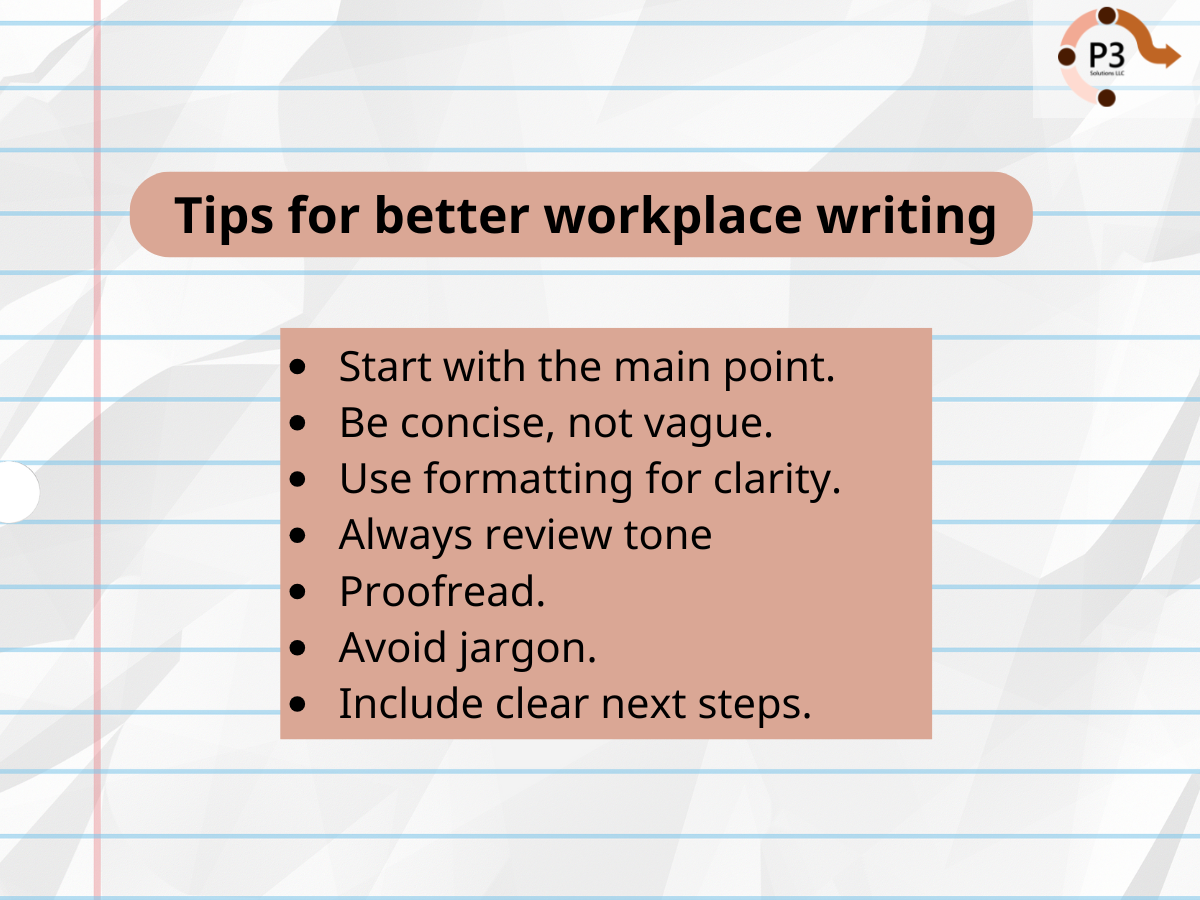
Start with the main point.
Use the BLUF method (Bottom Line Up Front). Say what you need first, then provide context. Respect your reader's time and avoid burying key actions.
Be concise, not vague.
Cut unnecessary filler. Replace "I just wanted to quickly reach out to touch base on…" with "Following up on…" Brevity is powerful when it is clear.
Use formatting for clarity.
· Bullet points to break down steps.
· Bold for emphasis or calls to action.
· Line spacing to prevent text walls.
Always review tone
Tools like Grammarly or Hemingway Editor help flag aggressive, overly formal, or confusing tone. But nothing replaces re-reading your message from the recipient’s perspective.
Proofread. Especially when it matters
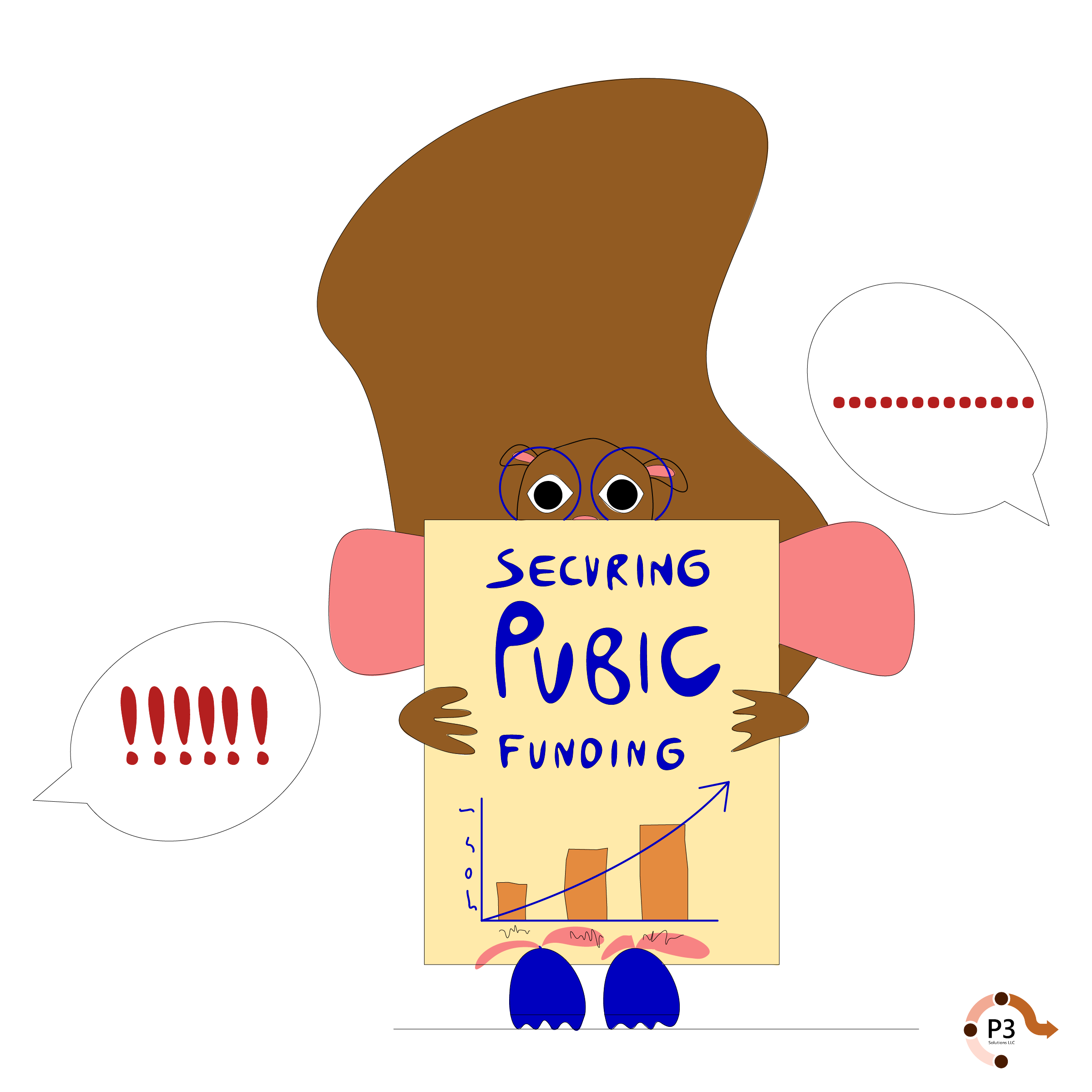
Wendy never checks her spelling! Don’t be like Wendy! Image courtesy of Hadi Madwar.
Check for grammar, typos, and clarity before sending a client proposal or sensitive internal update. Poor writing in important documents can undermine trust.
Avoid jargon
Unless you are writing for a technical audience, keep language simple and accessible. Use plain English to improve understanding across roles and departments.
Include clear next steps.
Never assume your reader will know what to do. Always state who is responsible, what you expect, and when it is due.
Building a writing-conscious culture
Poor writing extends beyond the individual to the entire workplace. Create a workplace culture that prioritizes clear, respectful, and effective written communication, or get help from someone who can (like P3 Solutions).
This culture has to start at the top. Leadership has to model concise, thoughtful emails with clear written feedback so that the rest of the organization can follow suit.
Set clear standards
Develop internal guidelines for tone, formatting, and communication channels. Define what “good” looks like, especially for common scenarios like email, instant messaging, and project updates.
Provide training
Too often, employers expect employees to write clearly without ever showing them how. Short workshops or online training on business writing can go a long way.
Use tools with intention.
Encourage employees to use writing aids or internal checklists to improve clarity and tone.
Encourage feedback loops
Make it normal to clarify messages or ask for rewording without judgment. A culture that encourages questions will naturally produce clearer communication.
Be inclusive in your language.
Clarity is vital in diverse or global teams. Plain language reduces confusion and fosters equity, especially for non-native speakers or neurodiverse individuals.
Link writing to performance
Good communication is not a soft skill. It is a business skill. When writing quality is included in performance expectations, it becomes part of how work gets done.
Writing is the backbone of modern workplace communication, and both on-site and remote workers must focus on it.
The confusion, delays, burnout, and damaged trust cannot be ignored. Look to diagnose and improve your communication practices with audits, training, or tailored strategy.
If your team wastes time and energy or erodes confidence with unclear writing, talk to us about how to fix it.
Further Reading
Instructional Solutions – The True Costs of Poor Business Writing
Wired – The Time We Waste on Slack and Microsoft Teams
Your Training Provider – Effects of Poor Writing in the Workplace
Tulane School of Professional Advancement – The Importance of Writing Skills in the Workplace
Wikipedia – Plain Language