Crafting a Value Proposition That Stands Out
Written by Joseph Philipson.
Originally published February 24, 2026.
Images have been generated using AI, unless otherwise stated.
Many organizations think their value proposition is clear. They can list their services, describe their methodology, and outline their tools in impressive detail. However, clients aren't looking for a catalog of capabilities; they want to know what will change for them. A strong value proposition is a statement of measurable impact that defines the shift from current pain to improved performance, from complexity to clarity, from effort to outcome.
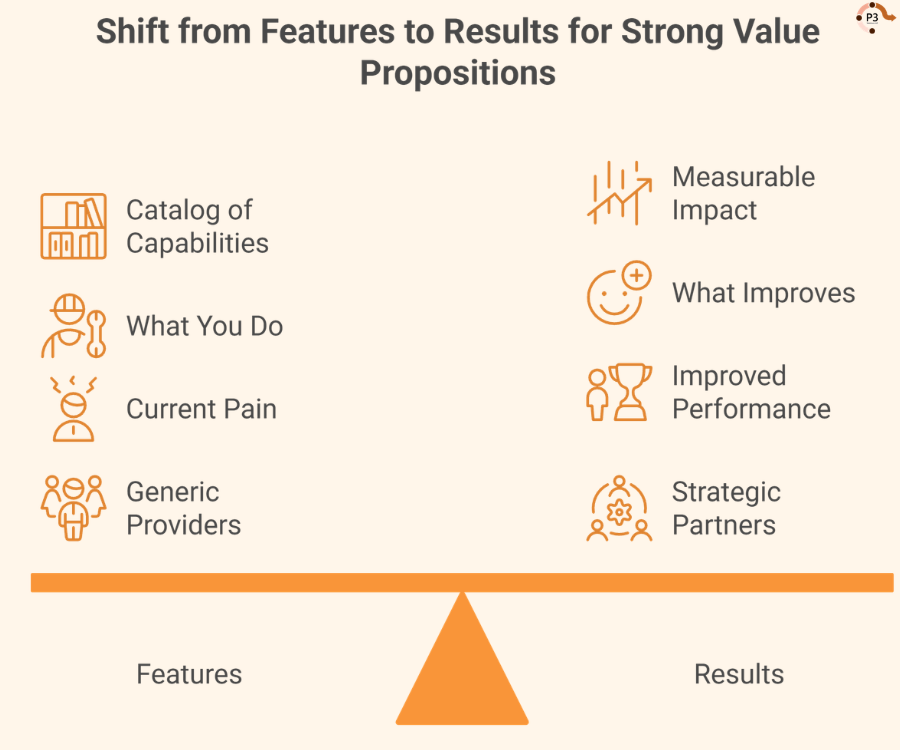
Shift from features to results for strong value propositions
Key Takeaways
A value proposition is not a list of services. It is a promise of measurable change.
Clients care less about what you do and more about what improves.
Strong value propositions define the shift from current pain to improved performance.
Clarity of impact is what differentiates serious strategic partners from generic providers.
The Feature Trap: Why Most Proposals Miss the Mark
Proposals fail because the value is poorly framed. Organizations talk about what they do, their process, their technology stack, their certifications, and their experience. All bragging rights, of course, but it wrongly assumes that the value speaks for itself.
It doesn't.
Decision-makers want to evaluate risk, return, and relevance. They want to know what problem will be solved, how performance will improve, and what measurable difference your involvement will make. Proposals that focus on features force clients to translate activity into impact, which they won't do.
Feature-first thinking can be costly. You can't differentiate yourself from competitors who offer similar services, after all. Unless you connect your methodology to a tangible shift in outcomes, it can't be persuasive. If everyone sounds the same, buyers look to price, familiarity, or perceived safety.
Most organizations create real value, reduce inefficiencies, accelerate decision-making, and increase alignment, revenue, retention, or performance. However, outcomes are often implied rather than explicit, and while the document reads well internally, it fails to resonate with clients.
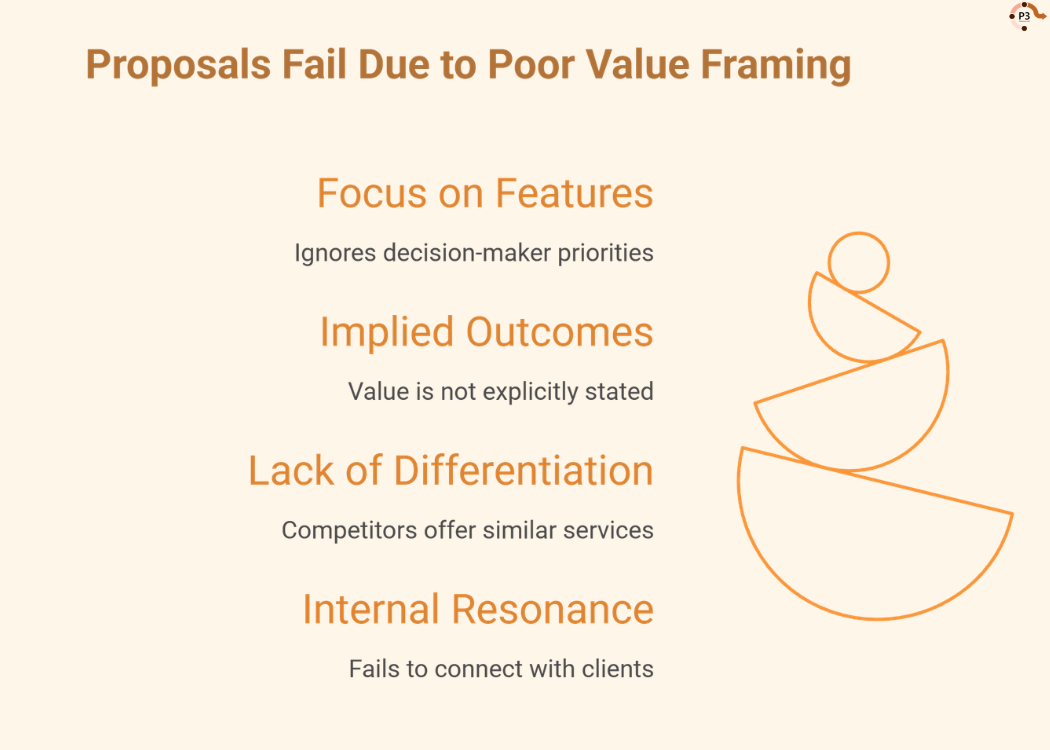
Proposals fail due to poor value framing
Escape the feature trap by shifting your perspective. Don't ask “What do we offer?”, ask “What changes for the client because we are involved?”. Then you can start really setting yourself apart.
Feature-heavy proposals assume value is obvious. It rarely is.
Decision-makers evaluate risk, return, and relevance, not activity.
When value is implied rather than explicit, differentiation disappears.
Feature-first thinking drives commoditization and price-based decisions.
The right question is not “What do we offer?” but “What changes because we are involved?”
From Features to Outcomes: Translating Capability into Measurable Change
You can't just change your wording; you have to change your thinking. Features describe what you provide, outcomes describe what you'll improve. What connects the two? Measurable change.
Identify the client's real problem first and foremost; don't just focus on the service you want to deliver. Where is performance stalling? What risks are they looking to reduce? Are they experiencing friction?
Strong value propositions should start with the client's current state, making the cost of inaction clear.
Now, connect your capability to a defined shift. Offer strategic planning and demonstrate the resulting changes. Will there be shorter decision cycles, clearer accountability, or faster execution? If you're providing organizational development, what do you improve? Reduced turnover, stronger cross-functional alignment, or increased productivity?
Measurable indicators are key here. Credibility comes from quantified outcomes. Timeframes, percentage improvements, cost savings, efficiency gains, or risk reductions are all ways to anchor your value in reality. You don't have to be perfectly precise, but you'll need evidence. Directional metrics can be enough to show your work produces tangible results.
Consider rewriting feature statements as results statements. Rather than "We deliver comprehensive performance diagnostics," say "We identify performance gaps that reduce operating efficiency by up to 20 percent within the first 90 days." Don't say "We facilitate executive workshops"; say "We align executive teams around three measurable priorities, reducing strategic drift and accelerating execution."
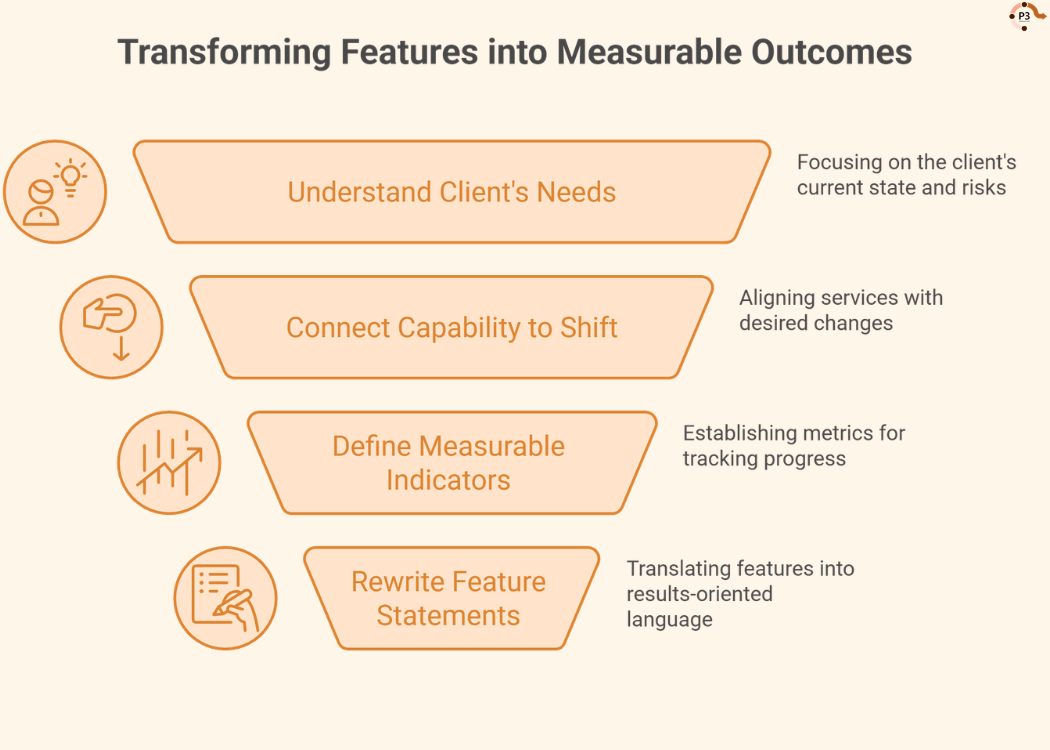
Transforming features into measurable outcomes
Differentiation is clearer with features translated into measurable change. Competitors will offer similar services, but do they articulate the specific results they produce? Buyers aren't buying the process; they're investing in improvement and results. The more you define that improvement, the stronger and more persuasive your value proposition becomes.
Features describe inputs. Outcomes describe improvement.
Strong value propositions begin with the client’s real problem.
Measurable indicators anchor credibility in evidence.
Even directional metrics increase persuasive power.
Buyers invest in performance shifts, not processes.
What Feature-First Thinking Looks Like Inside Organizations
The “Features!” banner is both a proposal problem and a cultural habit. Long before a client sees a pitch deck, feature-first thinking has already taken root within the organization. You can see it in status updates listing activity over impact. Teams report on meetings, workshops, and documents produced. The assumption is that motion equates to progress. Activity isn't the same as improvement if you can't measure it.

Wendy clearly displaying signs of feature-first thinking
You can see it in language, too. Internal communications are full of jargon, frameworks, and proprietary terminology. Complexity conceals a lack of sophistication. Clarity is upstaged by sounding advanced. Expertise isn't the problem; it's translation. Teams don't clearly articulate what changes result from their work, and the ambiguity carries over to the client.
Vanity metrics are another symptom: engagement scores, attendance numbers, slide counts, and system logins. Don't get us wrong, these can all have relevance, but they don't automatically demonstrate impact. A workshop attended by fifty people doesn't mean that behavior changed at all. A dashboard focused on time tells you nothing about whether decisions improved. Organizations that celebrate inputs over outcomes naturally think in terms of features.
Feature-first thinking can result in overpromising. Describing value in broad, unmeasured terms can lead to expectations that snowball. Without measurable anchors, credibility can start rotting. Clients may be initially impressed by confident language, but trust compounds with evidence, not words.
This shift takes internal discipline, though. Leaders have to ask the right questions. They need to ask about what's changed, how we know, and what evidence supports the claim. Teams reporting outcomes over activity will naturally sharpen their messaging. Value becomes clear, and this clarity leads to proposals and client conversations.
Feature-first thinking is often an internal habit before it becomes a proposal problem.
Activity does not equal impact. Motion does not equal progress.
Jargon and vanity metrics obscure value rather than clarify it.
Broad, unmeasured claims erode credibility over time.
Leaders must ask: What changed? How do we know? What evidence supports it?
Lower the Banner. Raise the Results
Strong value propositions aren't there to impress; they're there to clarify. Don't describe activity, define change. These differences are subtle, but they're incredibly important.
Shift the conversation from what you do to what improves. Move from inputs to outcomes. Go from frameworks to results. Measure value, not effort. This shift will strengthen performance and sharpen internal thinking, with teams evaluating their own work through impact.
Competitors may offer similar services, tools, or even experiences, but differentiation can truly happen when you anchor promise in evidence. Not every competitor will be disciplined enough to do this.
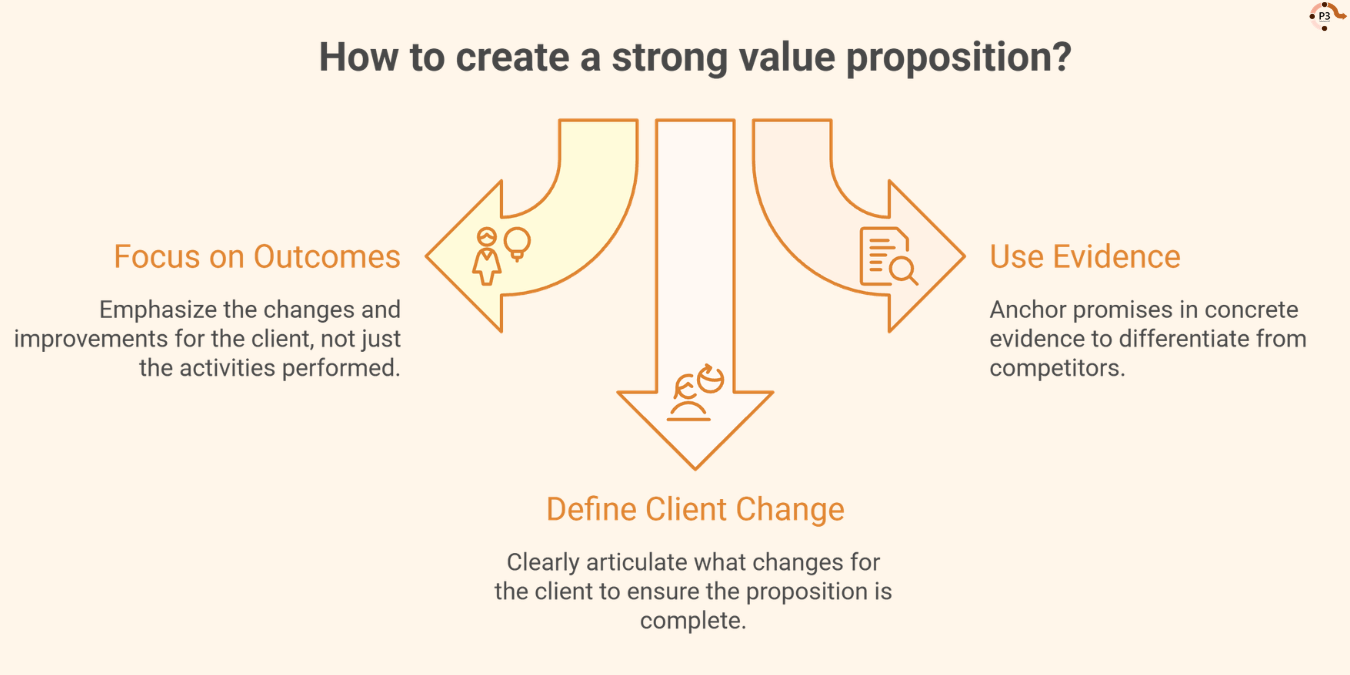
How to create a strong value proposition?
Features describe what you do, metrics prove what you do, and outcomes will persuade clients that you can do it if you don't clearly answer the question "What changes for the client?" in your value proposition, then you're not finished.
Strong value propositions clarify, but they do not impress.
Shift from inputs to outcomes and from effort to measurable value.
Evidence is the foundation of differentiation.
Features describe. Metrics prove. Outcomes persuade.
If you cannot clearly define what changes for the client, the value proposition is incomplete.
At P3, measurable change matters. We help organizations go from capability listed to performance shifts that stand up to scrutiny. The results speak for themselves.
“P3 Solutions has been instrumental in enhancing our proposals…they bring expertise and insights that have significantly benefited our responses and our win rate. With P3’s assistance and ability to quickly turn around our content, we are better equipped to submit the kinds of proposals that small businesses need to thrive in today’s highly competitive environment.”
Turn complexity into clarity and effort into results. Contact us today!
Further Reading:
Organizational transformation: Is your organization ready for transformation?
Poor Communication in the Workplace: a five-part series on poor communication.
Proposal Coordinators: The Backbone of Every Winning Submission. What’s coordination got to do with it?