
The Invisible Link
Donor Agencies, Taxpayer Money, and Public Accountability
Written by Joseph Philipson.
Originally published October 16, 2025.
All images have been generated using AI.
Ordinary taxpayers, the people who ultimately finance development funding, rarely see where their money actually goes. Donor agencies, multilateral organizations, and NGOs may put out publicly available data in the name of "transparency", but this data is rarely contextualized in a way that can be fairly labeled "accountability". What is this invisible link between taxpayers and the outcomes their money funds? How has it weakened, and how can NGOs and donors rebuild trust through genuine accountability and transparency?
The hidden journey of public money
Whatever the currency, every dollar, pound, or euro that funds an NGO project originated as public money collected through taxation. It goes a long way, and its path is often invisible; from treasury allocations to aid budgets, donor agencies, and multilateral funds, before it finally ends up in the organizations implementing the projects on the ground. Each stage of this journey has its own reporting systems, priorities, and language of accountability.
International donors have taken steps towards greater openness and transparency over the past decade. The Aid Transparency Index 2024 from Publish What You Fund reported that over half the world's major donor organizations now publish timely, machine-readable data about their disbursements and performance indicators.
In countries like the US and the UK, this process is highly transparent, with USAID and the Foreign, Commonwealth & Development Office (FCDO) both receiving "very good" scores for their efforts. However, data quality and frequency can vary wildly. The best-ranked agencies don't always make information accessible or understandable to the general public.
Donors may be more transparent than ever, but the public is still largely unaware of where their money is going. After all, spreadsheets and XML files rarely cover how aid is used or what impact it has in a way that's understandable to real people. Accountability ends up siloed, with governments reporting to parliaments, agencies reporting to oversight bodies, and NGOs reporting to donors. Yet the very citizens whose money made it possible are left out of the process altogether.
“Better-quality and more comprehensive data are key to greater accountability and greater trust in the development co-operation system.”
The OECD's Development Co-operation Report 2023 said that “better-quality and more comprehensive data are key to greater accountability and greater trust in the development co-operation system”. Transparency isn't just about disclosure; it's about enhancing the quality, consistency, and utility of shared information. Data alone isn't enough to establish public trust. There must be reliable, interpretable, and relevant information for taxpayers. Openness that lacks accessibility and meaning is merely symbolic, offering citizens no real accountability.
When accountability gets lost in translation
Accountability is frequently used in the development sector, but it often feels like a buzzword, especially when poorly defined. Accountability often splinters once aid funding leaves a government department. Donor agencies, contractors, and NGOs all have the same obligation to account for the money, but they do have some freedom to interpret it as they see fit. Public responsibility ultimately becomes distorted into a technical exercise defined by procurement rules, log frames, and audit requirements.
The USAID Office of Inspector General (OIG) has shown that gaps appear when responsibility is shared. It found that many UN agencies and foreign NGOs fail to share required information about misconduct, despite their contractual obligations to do so. For example, between October 2019 and June 2024, there were 519 reported instances of potential misconduct to USAID from the World Food Program, but only 29 directly to the OIG.
OIG investigations were also frequently delayed by UN agencies invoking diplomatic "privileges and immunities" to withhold investigative materials, despite agreements that explicitly allowed access. If inspectors aren't given timely access to UN financial data and investigative records, taxpayer funds are at risk of fraud and misuse.
Certain NGOs even refuse to share personally identifiable information (PII) for investigations, citing national privacy laws such as the EU's General Data Protection Regulation. This practice is particularly problematic for programs funded by US taxpayers, as it's used to shield against oversight. The suggested solution is explicit award conditions for non-US implementers to share PII when necessary to determine credibility and investigate allegations.
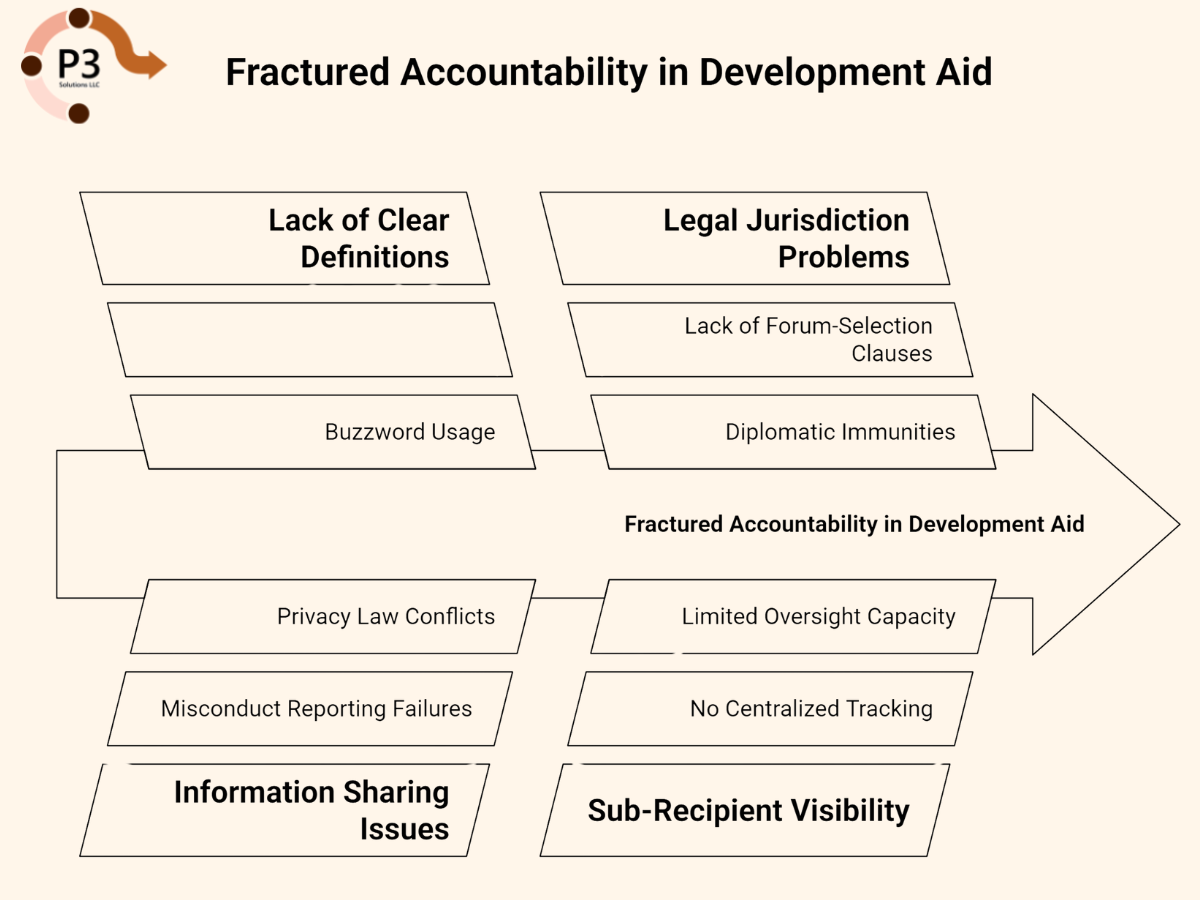
Fractured accountability in development aid
Accountability is also weakened because of legal jurisdiction. The OIG cites a case against a British-based NGO that was dismissed because the USAID contract lacked a forum-selection clause, which meant US courts didn't have the authority to hear the case. It's recommended that USAID incorporate clauses to address this issue and protect the government's ability to recover funds that have been fraudulently used.
Accountability is also weakened through the lack of visibility when funds flow to sub-recipients. Without a centralized system to track sub-awards tied to prime contracts, delays in investigations and limited oversight capacity remain difficult to resolve.
All of these issues are part of a larger picture where accountability extends across borders and institutions, fracturing in the process. The system may appear regulated, but it is actually fragmented. Every actor is accountable on paper, but since no one is fully accountable, accountability can easily be shirked.
Oversight under pressure: what happens when donors struggle to monitor their own systems
The USAID OIG's February 2025 advisory has practical examples of how oversight can fail. The USAID's Bureau for Humanitarian Assistance (BHA) lost most of its operational capacity during an 85-day government-ordered pause on foreign aid that made normal controls "largely nonoperational".
With approximately 90% of BHA's worldwide workforce placed on administrative leave, USAID's capacity to disburse and safeguard its humanitarian assistance programming was "significantly impacted". The agency's ability to monitor partners or respond to emergencies effectively ceased.
Shipment delays and conflicting guidance resulted in $489 million worth of food aid being stranded in ports, transit, and warehouses around the world. Around 500,000 metric tons of additional commodities were held "at sea or ready to be shipped", with increased risk or "spoilage, unanticipated storage needs, and diversion". Each delay was not only a waste, but lost traceability for taxpayer-funded goods.
Partner vetting and third-party monitoring were also effectively halted. The counter-terrorism vetting unit was told not to report to work, which meant that partner vetting wasn't taking place. Third-party monitoring contracts were halted in conflict zones, and USAID was unable to confirm whether assistance reached its intended beneficiaries.
Staff reductions also restricted communication channels. The agency's ability to inform Congress of each diversion or destruction of funded assistance, a statutory duty, was greatly hindered.
Even temporary disruptions can paralyze accountability. Even sophisticated donor systems can be paralyzed by political decisions upstream. Billions in public funds were left unmonitored, and accountability effectively dissolved.
The taxpayer’s blind spot: why perception matters as much as data
A public misunderstanding of aid poses a threat to the entire aid system. There are many misconceptions about aid, with over 86% of US adults overestimating how much foreign aid makes up of the federal budget.
On average, they believe 26% of the federal budget goes to foreign aid, when it's actually much closer to 1%. When respondents were informed of the actual figure, the proportion of those who said the US was "spending too much" went from 58% to 34%.
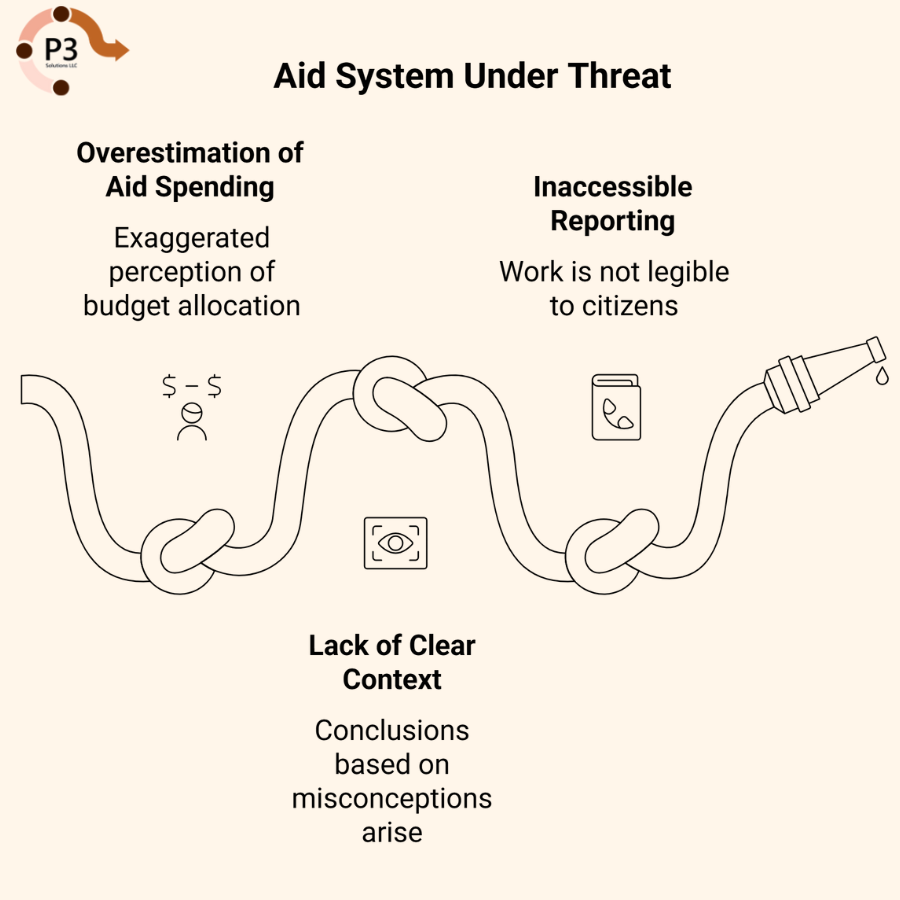
Aid system under threat
Without a clear context, citizens will draw conclusions based on misconceptions. Given that 67% thought cutting USAID would lead to increased illness and humanitarian crises globally, a majority still believed spending was too much, despite not knowing the actual amount being spent.
NGOs need to make their work legible and credible to ordinary citizens. They can't just report to technical audiences. There's also an essential duty to ensure that the narrative, framing, and translation are accessible to the public.
Transparency is not the same as accountability
Transparency is the act of making data available, while accountability is taking action based on it. The Aid Transparency Index 2024 found that more than half of the world's major donor organizations disclose data in line with the International Aid Transparency Initiative (IATI) standard. However, many still "struggle to make their data useful or usable by those outside of government". If the information is still unreadable to non-specialists, how accountable are they really being?
Disclosure requirements can be met with spreadsheets, but citizens often have little to no idea whether funds reached their intended destination or achieved the desired impact. A potential solution is pairing openness with usability. The United Kingdom's Aid Transparency Commitment (UK0108) requires departments to publish IATI data as well as offer plain-language explanations of objectives, results, and delivery partners. This resulted in the UK improving its ranking in the Aid Transparency Index, as well as increasing public awareness of development spending.
Rethinking responsibility: from donors to the public they represent
In the US, USAID's mechanism tends to focus on reporting to Congress and the OIG, rather than communicating directly to the public. This is also true in Europe, where the European Commission's Transparency Portal provides detailed project data, assuming that citizens will seek it out, interpret it, and draw their own conclusions. Aid funded by taxpayers should be reported to them in a language they understand, not hidden behind technical insider language.
Accountability should be more about the relationship with the public than a regulatory obligation. Donors and NGOs need to adopt practices that invite citizen oversight, such as accessible dashboards, public consultations, participatory evaluations, and storytelling that clearly indicates where the money is going. Trust is built on what people understand, not just the information that's put out there.
Building back the invisible link
With accountability fractured across institutions, you must rebuild it by reconnecting the taxpayer with the ultimate recipient of the aid. Donors and NGOs can't simply disseminate data and expect it to close the gap sufficiently; they must change how they communicate and engage.
Clear and proactive communication can help counter misinformation about foreign aid spending, especially when it's reframed as public storytelling rather than bureaucratic data disclosure. This is particularly true with skeptical audiences.
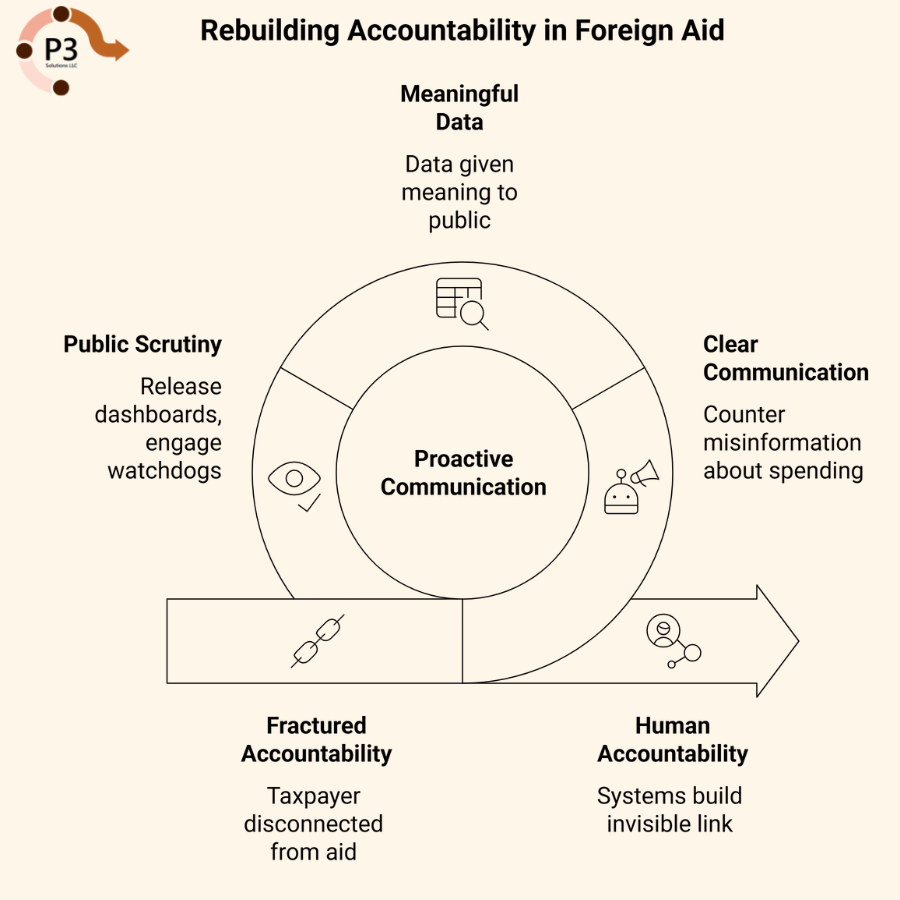
Rebuilding accountability in foreign aid
Data needs to be given meaning, and this meaning has to find its way back to the public, not just to those seeking it out. Communication must be an integral part of oversight, which includes publishing accessible summaries of results, explaining how funds are allocated through partnerships, and demonstrating how local voices influence outcomes. Donor agencies can invite public scrutiny by releasing plain-language dashboards and engaging with civil society watchdogs.
Accountability is about relationship building. Organizations need to work towards designing accountability frameworks that are ultimately human, with systems that build this invisible link.
Further Reading:
Bond: The power of transparency fighting disinformation and defending USAID.
P3 Solutions: The shrinking grant pool.
P3 Solutions: When proposals become pitches.
P3 Solutions: Competing without losing your soul.
P3 Solutions: What happens when donors walk away.