
The Shrinking Grant Pool
Why NGOs Must Now Compete Like Businesses
Written by Joseph Philipson.
Originally published August 5, 2025.
All images are P3 originals, courtesy of the P3 team.
Non-governmental organizations generally attracted funding through the good that they did. Traditional grants weren't necessarily abundant, but economic pressures, shifting donor priorities, and reduced public funding are making it far more difficult for nonprofits. Securing funding now requires strategic thinking, operational efficiency, and outcome-driven accountability, which are traditionally associated with the private sector NGOs now have to act and compete like businesses, not just to grow, but to survive!
The Shrinking Pool of Grant Funding
The nonprofit sector faces a sobering reality. Grant funding is neither guaranteed nor guaranteed to grow. Shifting government priorities, austerity measures, and competing budget demands are constricting public funding streams. In the U.S., for example, agencies such as USAID, NEA, and HUD have either been cut or left to stagnate. As a result, nonprofits are now scrambling for alternative funding avenues. This pattern is observed globally, with crisis response, economic recovery, and national priorities often taking precedence over civil society support.
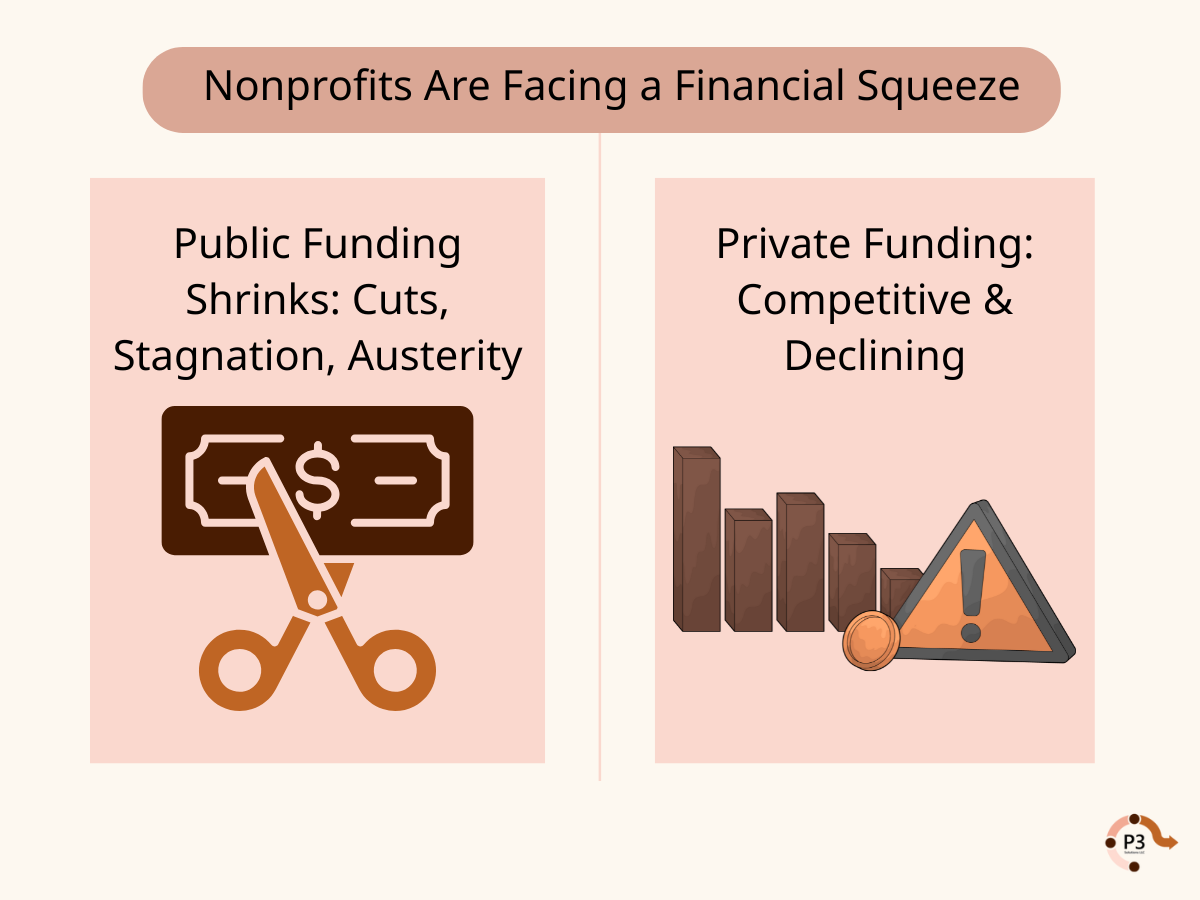
Nonprofits are facing a financial squeeze.
Private grantmaking has also failed to fill the gap. Major foundations continue to disburse substantial resources; however, these tend to be allocated to larger, well-established institutions. Small to mid-sized NGOs are struggling to compete. Grantmaking from donor-advised funds (DAFs) fell from $55.53B in 2022 to $54.77B in 2023. It might not look like much, but you should remember this is only the second decline in grantmaking since 2007 (when they started recording data).
The nonprofit sector is under immense pressure. Funders expect more proof, faster results, and leaner operations. NGOs must now treat funding acquisition as a competitive marketplace, rather than a mission-aligned partnership.
A More Competitive Landscape for NGOs
The shrinking grants pool has resulted in increased competition among NGOs. Not only that, but every funding channel is becoming more intense. 56% of NGOs impacted by the U.S. funding freeze are scrambling to find alternative financing resources. This affects not only humanitarian groups but also nonprofits in the arts, culture, education, and development.
A study of U.S.-based NGOs in foreign aid found that increased competition correlates directly with tighter administrative budgets resulting from pressures to be more efficient, which leads to a fundraising scramble. We have been aware of this phenomenon since at least 2010, yet nobody has addressed it effectively.
NGOs are operating in an environment where donor bargaining power is rising sharply, further compelling them to adopt a more business-like approach in their efforts to secure funding. The DNA of NGOs is evolving, with increased investment in fundraising infrastructure, including staff, CRM systems, and marketing, to differentiate themselves from competitors. Smaller or local NGOs are either squeezed out or forced into partnerships to keep going.
In short, this is evidence of the shift in the ecosystem within which NGOs operate, from cooperative to competitive. In such a crowded marketplace, performance, differentiation, and relationship management are key to survival, with organizations adopting market-style strategies to remain competitive through targeted proposals, donor segmentation, and professional branding.
The Rise of Market-Driven Models in the Nonprofit Sector
An increasing number of NGOs are now embracing market-driven strategies. Ultimately, this blurs the lines between charitable missions and business operations, with organizations developing revenue-generating models such as fee-for-service, social enterprise, and impact investing. These options, given the circumstances, offer longer-term sustainability and autonomy in the face of tightening grant pools and donor expectations.
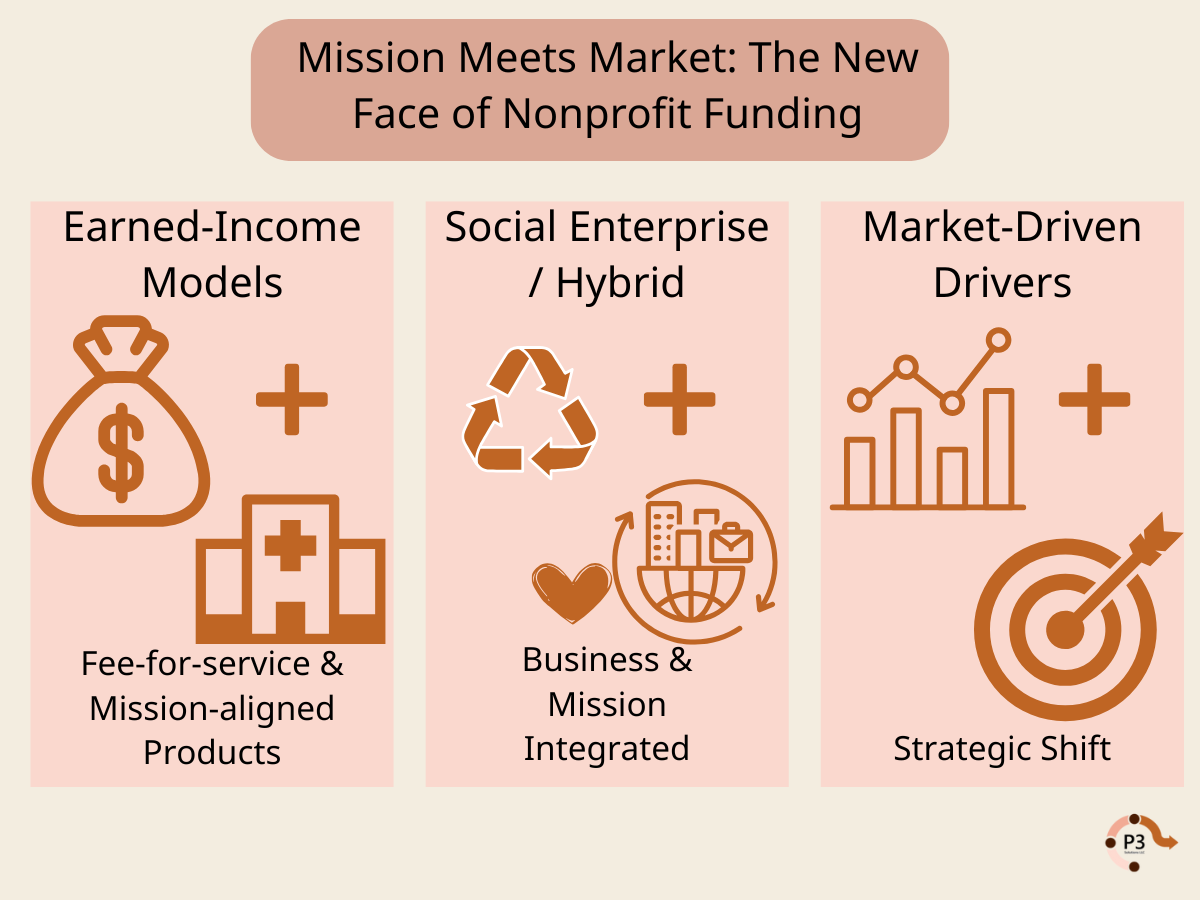
Mission meets market: the new face of nonprofit funding.
Earned-Income Models
Many nonprofits are now operating fee-based services and selling mission-aligned products. From healthcare services to educational programs, these private fees account for over half of the sector's total revenue, amounting to more than $1 trillion annually.
Social Enterprise & Hybrid Models
Social enterprises that embed commercial activities into their mission delivery have seen success. When traditional funding stalls, these evolving business models serve as key financial pillars, as evidenced by their significant impact on nonprofit funding.
Drivers and Trade-offs
Marketization, for lack of a better word, comes with clear benefits. Revenue diversification, reduced dependence on restricted grants, and potential for scale are all products of this. Over 90% of large, successful nonprofits focus their fundraising on one or two dominant income sources before building dedicated internal capabilities to support them.
NGOs are actively transforming into hybrid enterprises that offer services, launch businesses, and invest in projects. Naturally, this requires strategic clarity, operational discipline, and a willingness to confront the trade-offs between mission and margin.
Internal Strain and the Need for Strategic Evolution
The reduced grants and donations aren't just an external battle among NGOs; they also come with an internal operational strain. The "nonprofit starvation cycle" occurs when organizations underfund critical infrastructure, such as finance, HR, IT, and fundraising. When funders prioritize low administrative ratios over long-term health, nonprofits end up operating with fragile backbones, cutting overhead and underreporting costs, which hurts their overall sustainability. 56% of nonprofit leaders plan to reduce overhead even further, which could threaten their ability to manage growth, maintain compliance, or even innovate. These organizations run the risk of becoming vulnerable to mission drift and burnout.
Organizations now have to rely on strategic partnerships and coalitions more than ever. Whether through shared services, joint grant applications, or pooled capacity-building, organizations need to lighten their financial burdens. The NGOs that formalize partnerships through memoranda of understanding, shared governance, and co-funding mechanisms are more likely to be able to deliver the outcomes-based proposals that funders are after. Effective coalitions, like with corporate or institutional partners, can deepen impact, reduce duplication, and allow organizations to focus on mission.
New Approaches: Innovation, Diversification, and Trust-Based Funding
What is the way out of the resource crunch and competitive pressures? NGOs must pioneer new approaches that incorporate business-style diversification, cross-sector innovation, and trust-based philanthropy.
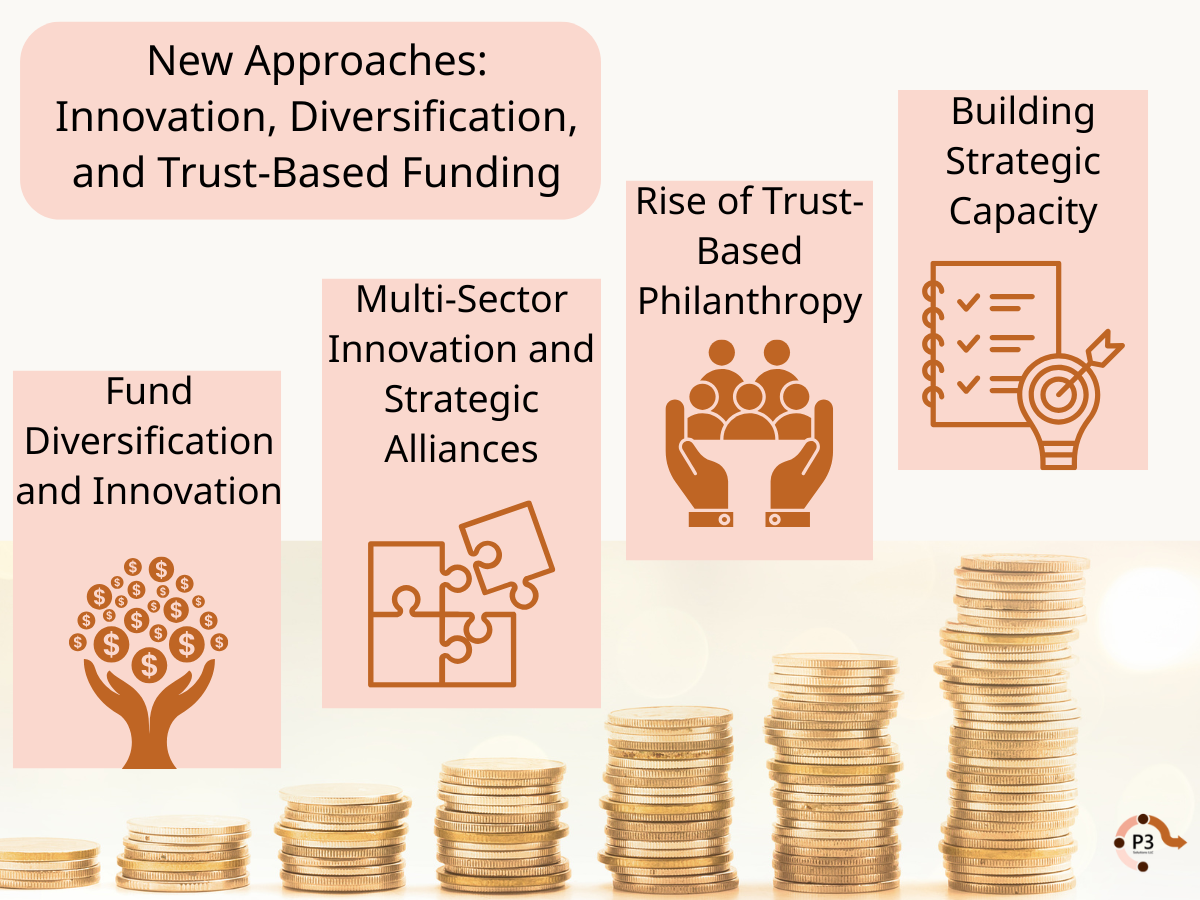
New approaches: innovation, diversification, and trust-based funding.
Fund Diversification and Innovation
In the face of dwindling restricted grants, NGOs must pursue multiple income streams, including major individual donors, corporate sponsorships, earned income ventures, endowments, and planned-giving campaigns. Nonprofits diversifying are more resilient during economic downturns.
Multi-Sector Innovation and Strategic Alliances
Cross-sector alliances can pool resources, drive innovation, and increase resilience. Nonprofits can solve complex challenges in ways they couldn't alone by collaborating with governments, corporations, design firms, and local communities. Design for Good, for example, convened creation workshops across five countries with design experts, nonprofits, and affected communities to develop practical, mission-aligned service models.
These kinds of collaborations and alliances help NGOs share risk, reduce duplication, and stretch limited capacity while improving impact. However, they do require strong systems of shared governance, joint funding mechanisms, and clear accountability.
Rise of Trust-Based Philanthropy
One encouraging trend for reshaping relationships with NGOs is the move towards trust-based philanthropy. Rather than restricted, short-term grants, there's a movement from major funders like the Ford Foundation, Hewlett, and MacArthur to shift towards multi-year, flexible funding models that prioritize mutual accountability and strategic partnerships over compliance-heavy reporting and metrics.
Trust-based funding enables nonprofits to focus on their missions with less administrative burden, allowing them to invest in internal systems, leadership, and long-term planning for sustainable impact.
Building Strategic Capacity
NGOs must invest in strategic capacity to survive in the long term. This includes professionalizing leadership, upgrading financial systems, and developing benchmarked finance capabilities. Organizations with clear strategic plans and stronger internal systems report more program growth and better staff retention.
If your NGO needs to evolve and adapt, consider chatting with P3 Solutions about organizational development.
Further Reading:
Economic pressures: Rising Costs and Shrinking Donations: A Double Blow to NGOs
Shifting donor priorities: Navigating the Evolving Funding Landscape
Private-sector-style expectations: 23 Strategies for Nonprofits
Hybrid models and mission-driven enterprise: Transforming Nonprofit Business Models
When Proposals Become Pitches: Rethinking the Purpose of Grant Applications
Competing Without Losing Your Soul: What Does 'Winning' Look Like in the Nonprofit Sector?
The Invisible Link: Donor Agencies, Taxpayer Money, and Public Accountability