The Worst Practices in Proposal Development
Written by Rafif Jouejati.
Originally published May 12, 2026.
Images have been generated using AI, unless otherwise stated.
P3 is delighted to provide a clear, candid summary of the worst proposal-development practices we’ve seen. These practices frequently result in losing bids, burned-out teams, and damage to our clients’ credibility with contracting officers.
The Worst Practices in Proposal Development
(and why they help you lose work)
1. Treating the RFP as a Suggestion Instead of Instructions
The thoughtless practice
Skimming the RFP, assuming “we know what they want,” and writing what you want to say instead of what the evaluator is required to score.
Why it’s risky
Evaluators are required to score only what is explicitly written
Missing a required element = automatic point loss (or disqualification, even if not explicitly stated)
Even strong firms lose to weaker ones that simply follow instructions
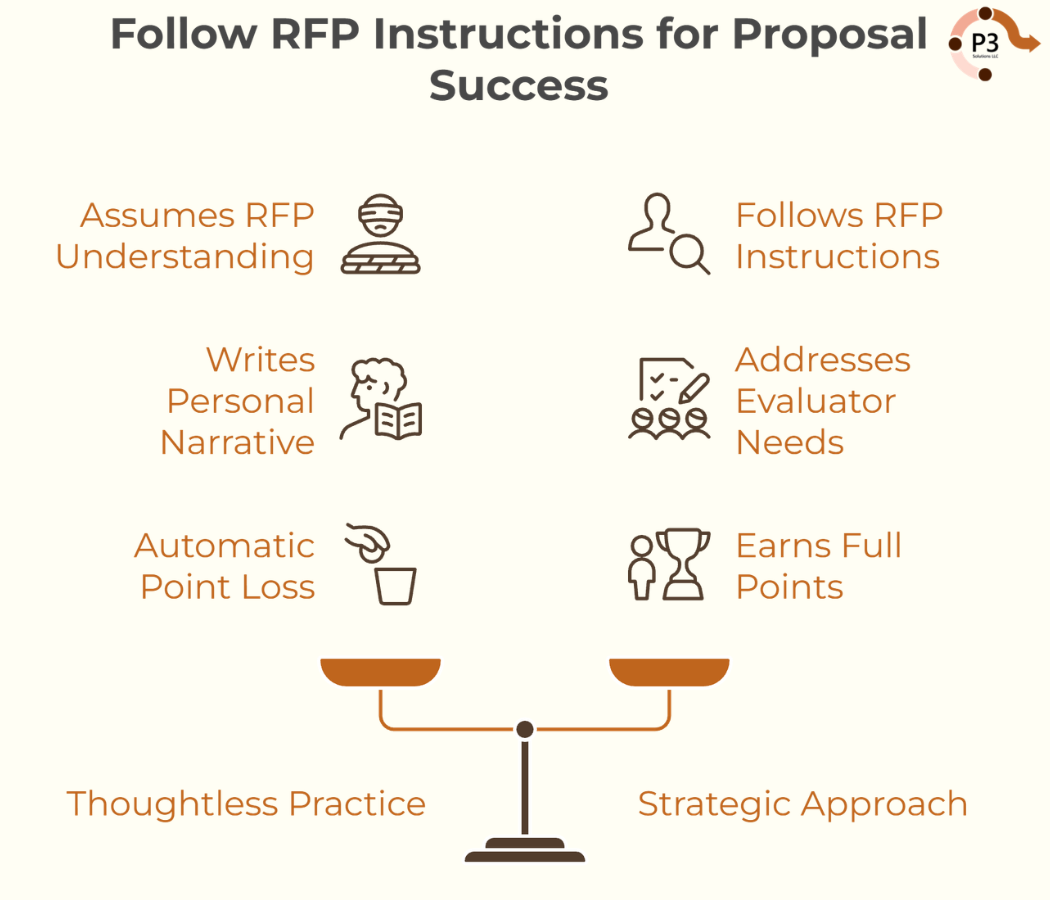
Follow RPF instructions for proposal success
Example
RFP asks for three risks with mitigation strategies
The proposal gives a polished narrative on “key considerations” with no risks identified
Evaluator cannot award points → zero score for the section
2. Writing for Yourself, Not for Evaluators
The thoughtless practice
Writing like it’s a thought-leadership white paper, internal strategy memo, or marketing brochure.
Why it’s risky
Evaluators skim under time pressure, looking for key words and concepts
If they can’t find the answer in seconds, they assume it isn’t there
Dense prose hides compliance and strengths
Example
Requirement: “Describe your stakeholder engagement approach.”
Answer: 2 pages of philosophy about collaboration
No bullets, no steps, no numbers, no methods, no proof points
Evaluator writes: “Unclear how engagement will be conducted.”
3. Using Generic Boilerplate Everywhere
The thoughtless practice
Dropping in reused text that “usually works” without tailoring it to the client, geography, or problem.
Why it’s risky
Evaluators recognize boilerplate instantly
Signals low effort and weak understanding
Makes your proposal interchangeable with those of your competitors and offers no clear value-add
Example
Proposal references “state agencies” and “county partners”
Client reference is a foundation working internationally
The evaluator wonders if this was recycled from another bid and deducts points for not providing a reference of similar size, scope, and complexity
4. Saying You’ll Do Everything (instead of making thoughtful choices)
The thoughtless practice
Listing every possible activity, method, framework, and tool to appear that we are providing a comprehensive approach.
Why it’s risky
Signals a lack of judgment
Makes delivery feel unfocused and unrealistic
Raises doubts about cost, timeline, and performance
Example
Workforce strategy includes:
Upskilling
Reskilling
Credentialing
Apprenticeships
Policy reform
Employer incentives
New institutions
The evaluator cannot score for prioritization, sequencing, trade-offs
5. Confusing Credentials with Value
The thoughtless practice
Leading with awards, logos, and firm history rather than being relevant to this problem.
Why it’s risky
Past success ≠ future fit
Evaluators care more about applicability than prestige
Overemphasis on credentials can feel arrogant or detached
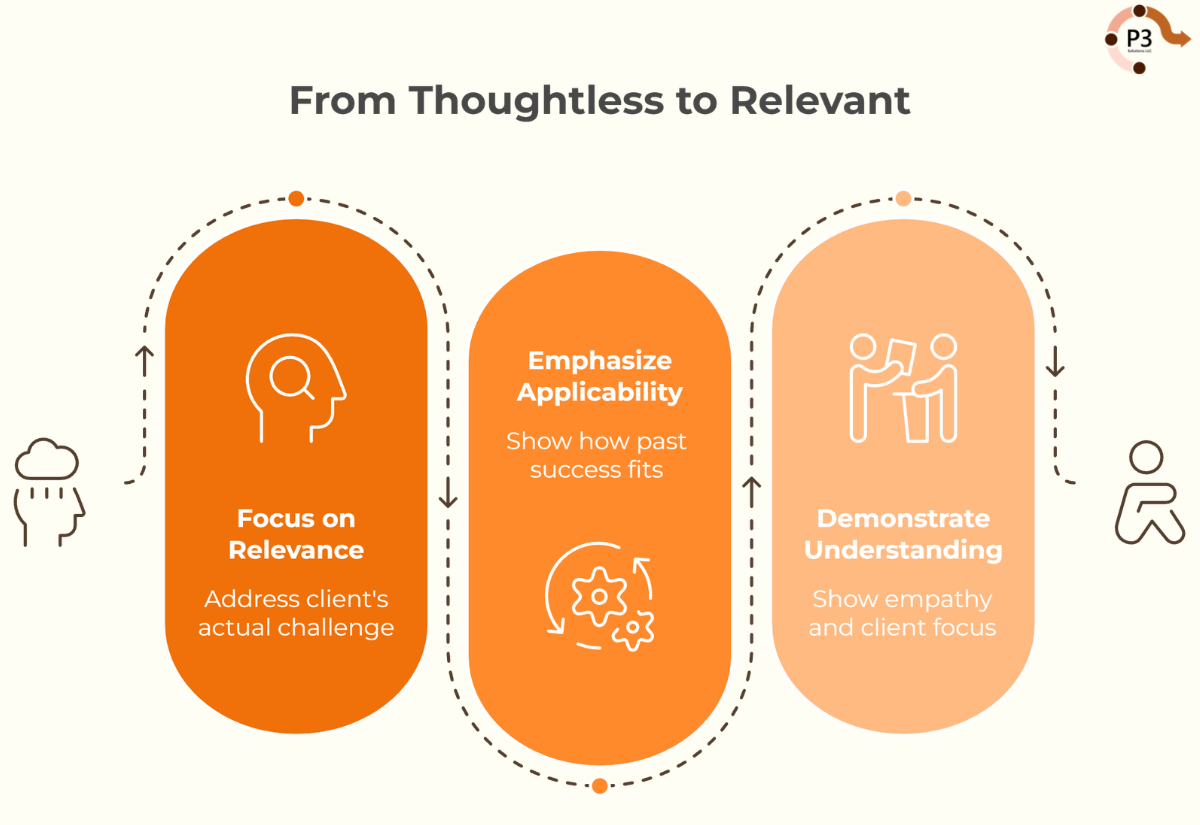
From thoughtless to relevant
Example
First 10 pages describe the firm’s global footprint for a local-government engagement
Only 1 page addresses the client’s actual challenge
Evaluator notes: “Strong firm, weak understanding of our needs.”
6. Letting Subject‑Matter Experts Write Unedited Sections
The thoughtless practice
Allowing SMEs to submit raw content directly into the proposal.
Why it’s risky
Inconsistent tone and structure
Overly technical or academic language
Sections answer the wrong question
Example
Economist writes 3 pages of methodology
RFP asked for “key findings and implications for action”
Technically impressive, but unscorable
7. Hiding Implementation Details Because “That’s Obvious”
The thoughtless practice
Assuming evaluators will take the time to infer how things will actually be done.
Why it’s risky
Evaluators cannot assume anything not written
Implementation credibility is often a top-scoring criterion
Vague delivery language raises execution risk
Example
Proposal says: “We will manage the project using best practices.”
No governance, no cadence, no roles, no escalation, no tools or identified practices
Evaluator writes: “Unclear how work will be managed.”
8. Treating Risk Sections as an Afterthought
The thoughtless practice
Listing obvious, generic risks to “check the box.”
Why it’s risky
Signals lack of real experience
Makes the team look naïve or performative
Missed opportunity to show judgment
Example
Risks listed:
“Stakeholder availability”
“Timeline constraints”
“Data limitations”
No specificity, no mitigation, no ownership, evaluators cannot determine if you understand the scope of their challenges
9. Over‑Promising and Under‑Explaining
The thoughtless practice
Making bold claims without showing how they’ll be achieved.
Why it’s risky
Evaluators discount unsupported promises
Raises credibility and delivery concerns
Can trigger tougher scrutiny of budget and staffing
Example
“We will deliver measurable impact in year one”
No metrics, no baseline, no mechanism
Sounds like marketing, not planning
10. Last-Minute Assembly (“Proposal Mad Libs”)
The thoughtless practice
Assembling sections at the last minute with minimal integration.
Why it’s risky
Inconsistencies across sections
Conflicting timelines, roles, or assumptions
Obvious lack of cohesion
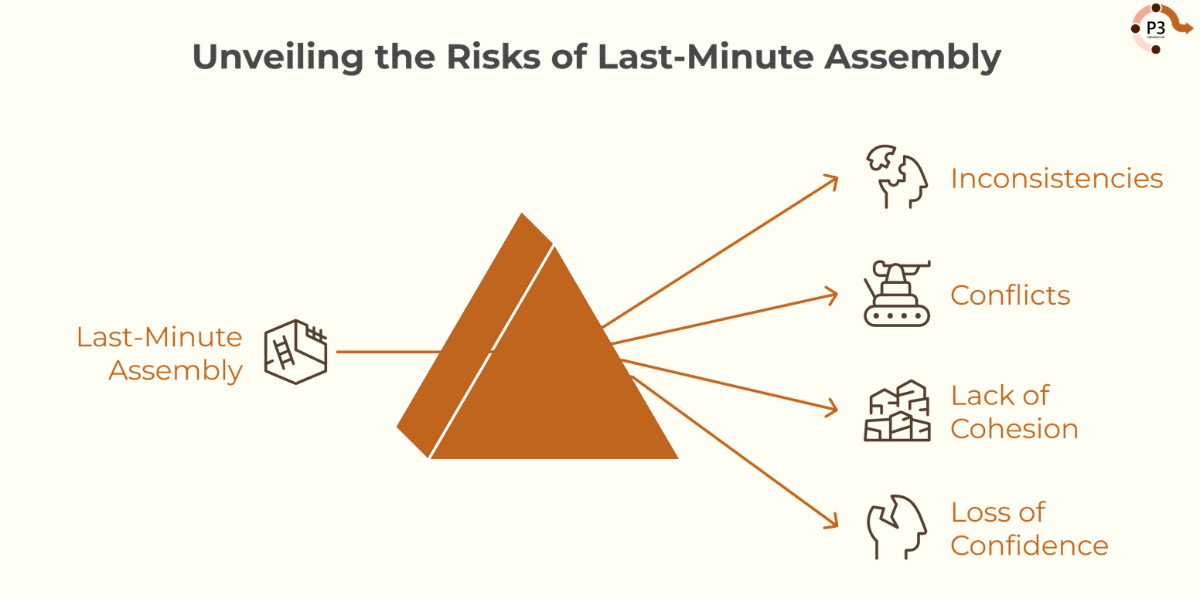
Unveiling the risks of last-minute assembly
Example
Technical approach says 6 months
Staffing plan assumes 12
Budget covers 9
Evaluator loses confidence fast
11. Ignoring Evaluator Psychology
The thoughtless practice
Assuming that evaluators read carefully and generously.
Why it’s risky
Many evaluators are tired, rushed, and risk-averse
They look for reasons to downgrade, not upgrade – after all, who wants to read 50 proposals?
Compliance, clarity, and conciseness beat cleverness every time
Example
Clever narrative buried under jargon
Competitor uses simple headings that mirror the RFP
Competitor wins
12. Failing to Assign a Single Accountable Proposal Lead (where is the “single throat to choke?”)
The thoughtless practice
“Everyone owns the proposal.”
Why it’s risky
No one owns compliance or coherence
No one enforces decisions
Endless late edits and scope creep, leading to BD budget explosions and staff burnout
Example
Partner A changes approach
Partner B changes staffing
No one reconciles them
Final proposal contradicts itself
It’s clear that at least four people wrote this proposal
The Meta-Failure Behind All of These
Almost every bad proposal practice comes down to one thing:
Optimizing for internal comfort instead of external evaluation.
Winning proposals are not the smartest documents.
They are the clearest, most disciplined, and most evaluator-friendly ones.
We know that every proposal effort is unique — that’s why P3 is a flexible and agile partner that supports you at every point in the proposal process. Contact us today!
Further Reading:
Uncovering the client’s real problem before writing the proposal.
Value propositions that stand out.