The Proposal Production Trap
Managing Time, Quality, and Resources
Written by Joseph Philipson.
Originally published July 1st, 2026.
Rushed proposals can lead to errors, weaker messaging, and less credibility. Teams can lose control of the whole process if time, quality, and resources aren't managed properly. Good proposal production needs structure, ownership, review time, and information control. Treat proposal development as a managed process with clear responsibilities, milestones, review activity, and final quality assurance.
A proposal also needs a clear customer-focused story, not just a completed document. If you don't protect both process and message, speed may end up being a double-edged sword that's quietly creating risk that you could easily avoid. This is the proposal production trap: finishing a proposal on time but without the proper controls.
Treat proposal production as a managed process, not a writing scramble.
Decide who owns the proposal before work starts, moving quickly.
Protect time for review, version control, and final quality assurance.
Why It Happens
Proposal production breaks down when the plan assumes ideal conditions. In practice, proposal work often falls to people with competing priorities, while the schedule fails to protect enough time for evaluation, review, and contingency.
As the schedule tightens, review is often the first thing to be squeezed. Drafts are scanned too quickly, compliance checks happen too late, and final approval becomes a deadline exercise rather than a real quality check.
Bid evaluation depends on clear planning, suitable resources, realistic timetables, and proper assurance, so a rushed internal review creates avoidable risk before the proposal reaches the client. The team may still be moving forward, but nobody is properly testing whether the proposal is complete, consistent, and convincing.
When roles, channels, and decisions are unclear, communication complexity can increase ambiguity across the work. Watch for the early signs:
The timetable assumes every contributor will respond on time.
Review time is being used to finish writing.
More than one draft is circulating.
Nobody can clearly explain what is still unresolved.
Final approval is becoming a deadline task rather than a quality check.
What Good Looks Like
Proposal production shouldn't feel chaotic. The team should know what needs to be done, who owns each stage, where the current version lives, and when review points are protected. Proposal management works best when responsibilities, milestones, review activity, and final quality assurance are clearly defined. With this, your team has a better chance of submitting work that is accurate, compliant, and persuasive.
Set Realistic Review Checkpoints
Define clear review stages before writing begins.
Include draft review, technical review, compliance review, and final review.
Assign an owner to each checkpoint so feedback does not drift.
Give reviewers a clear task, not just a vague request to “have a look”.
Protect review time instead of using it as spare writing time.
Use staged reviews to catch issues early, rather than discovering them at final approval.
Treat each checkpoint as a quality control point, not a delay.
Use Collaboration Platforms for Version Control
Centralize drafts, supporting evidence, pricing inputs, attachments, and submission documents.
Avoid sending editable proposal drafts through email chains.
Control editing access as the document matures.
Track comments, changes, decisions, and unresolved questions in one place.
Make sure everyone knows where the current version lives.
Use version control to support accountability when several people are working on the same document.
Practical Guardrails
Keep proposal production moving with practical guardrails. These shouldn't be complicated, but they should be agreed upon early in the process. ISO's guidance on quality management highlights the benefits of clear responsibilities, consistent processes, documented information, and reducing the risk of errors.
Limit late-stage contributors. Extra input near the deadline can help, but only when the person’s role is clear. Cross-functional work can stall when decision rights, feedback routes, and ownership are unclear.
Separate writing from formatting. Final formatting should happen once the content is stable, not while major rewrites are still underway.
Use a final review checklist. Check compliance, attachments, page limits, terminology, pricing, formatting, signatures, and submission instructions.
Control last-minute changes. If a late edit is necessary, make sure someone owns the decision and checks the impact across the whole proposal.
Keep unresolved issues visible. Open questions should be tracked clearly so they are not buried in comments, emails, or side conversations.
Don't slow the team down; prevent avoidable mistakes in the final submission. With clear guardrails, proposal teams can move quickly and safely.
The Wendy Test
Now let's see how our beloved squirrel colleague Wendy is getting on with this. Wendy's a well-intentioned worker, but she unfortunately makes a lot of easily rectifiable mistakes. Let's help her out.
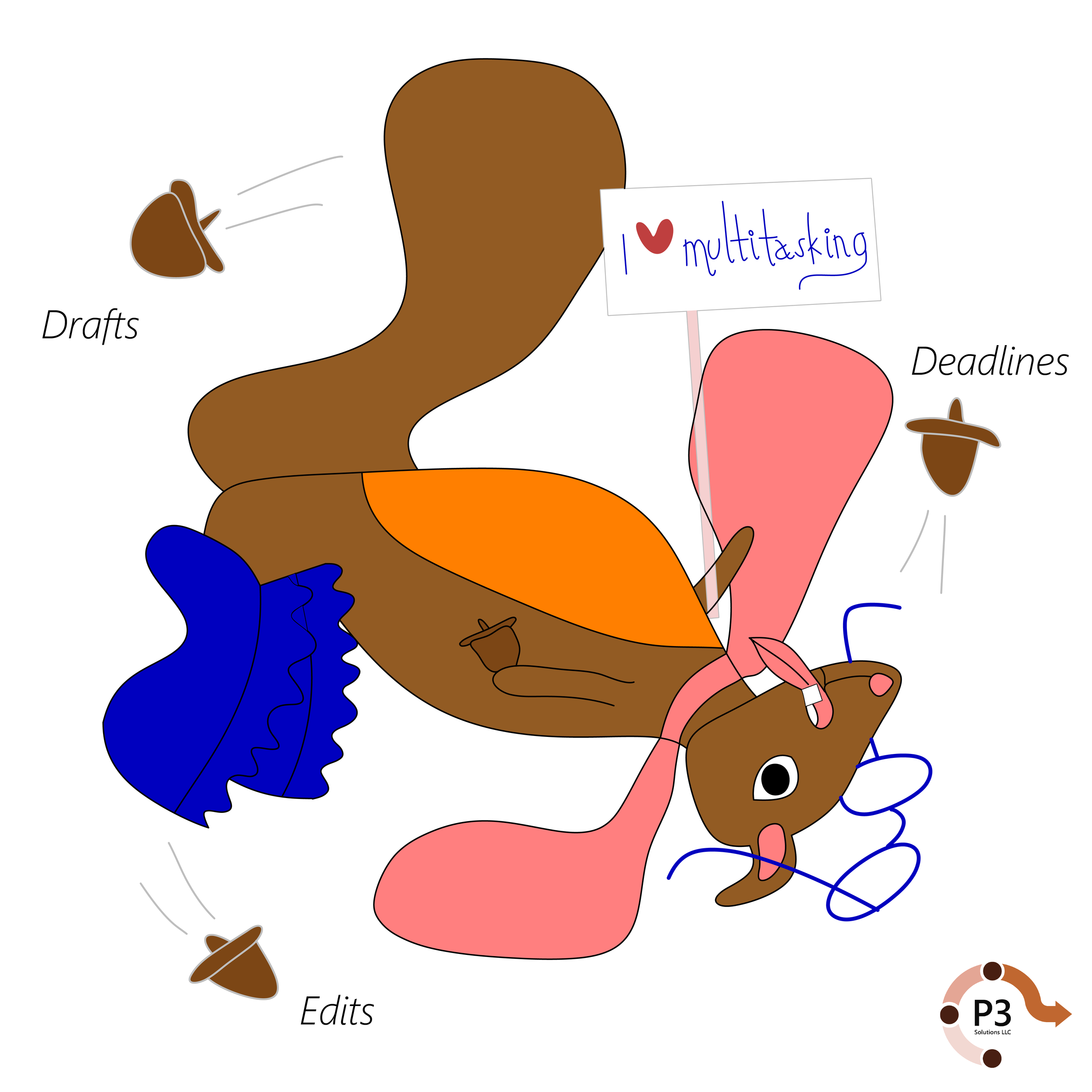
Wendy is juggling the drafts, edits, and deadlines, she’s doing it all. Image courtesy of Hadi Madwar.
Wendy is juggling the drafts, edits, and deadlines for a proposal. She's answering messages from technical contributors, copying comments from an email chain, updating an older version with "final_final" in the filename, and assuring everyone the proposal's still on track.
Wendy's working hard, but she's become the whole process. There's no content lock, with sections continually reopening. There's no protected review, so compliance comes too late. There's also no single source of truth, so people are working on different versions.
To make sure you don't have a Wendy, check for the warning signs:
If one person is chasing every missing answer, ownership is unclear.
If edits are being merged from multiple files, version control has failed.
If the team is still rewriting during final formatting, the content lock has slipped.
If compliance is only being checked at the end, the review plan was too weak.
If unresolved issues remain in emails, comments, or someone's memory, the team does not have control over them.
If late contributors reopen settled sections, the approval process is not protected.
If the proposal feels busy but nobody can clearly explain the current status, activity has replaced structure.
Rather than having people juggle more tasks, take tasks off their plates. Reset working versions, confirm owners, protect review time, lock finished parts, and make unresolved issues visible.
Strong proposals are planned, reviewed, and controlled. Don't slow everything down or add processes for their own sake. Give teams structure to maintain submission quality while still meeting deadlines.
Ownership, review points, version control, and practical guardrails may reduce the risk of errors, weak messaging, and last-minute confusion.
When activity starts to replace control, you're in a proposal production trap. Step back before the final push and check that the process is still working. Teams shouldn't have to rely on memory, goodwill, or heroic effort to get submissions over the line.
Need help with your proposal? Contact P3 solutions today to see how we can help.
Further Reading:
The worst practices in proposal development.
Uncovering the client’s problem before writing the proposal.
Crafting a value proposition that stands out.